Top 15 Best Wedding Venues in India
- Author: Natali Grace Levine
- Reading time: 13 min 27 sec
- Publication date: 08/12/2026
- Updated: 08/15/2026


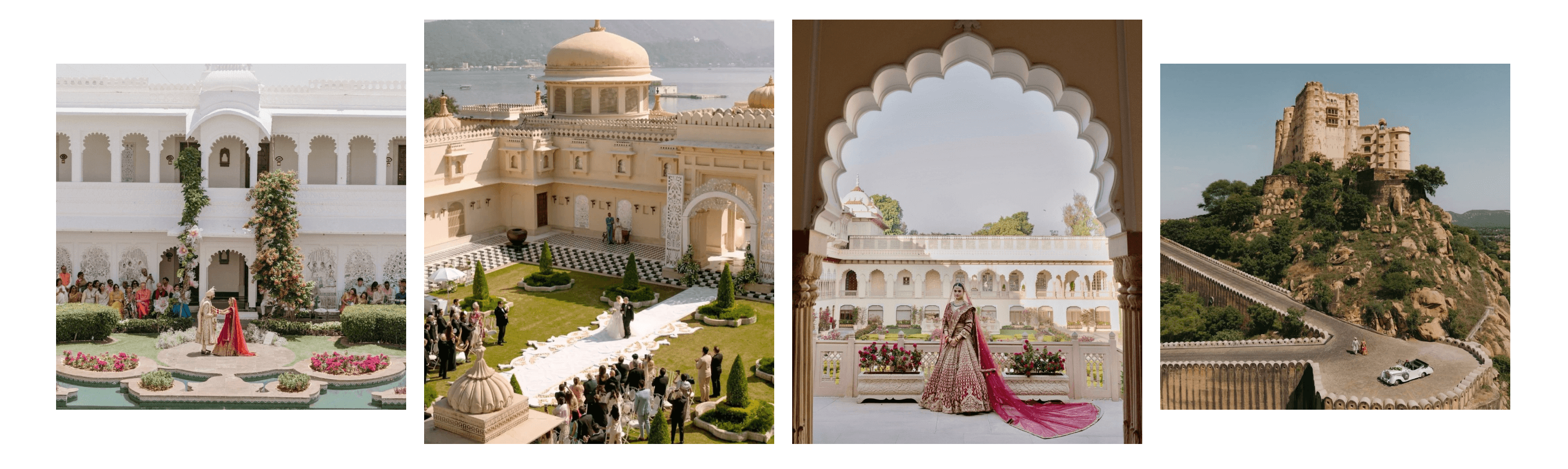
- The Oberoi Udaivilas, Udaipur
- Umaid Bhawan Palace, Jodhpur
- The Leela Palace Jaipur
- Six Senses Fort Barwara
- Raas Devigarh Palace, Udaipur
- Amanbagh
- Samode Hotel, Jaipur
- Rambagh Palace, Jaipur
- Taj Lake Palace, Udaipur
- Raffles Udaipur
- Alila Fort Bishangarh, Jaipur
- Wyndham Garden Udaipur
- Suryagarh, Jaisalmer
- Fairmont Jaipur
- Mundota Fort and Palace, Jaipur
- FAQ
India doesn't just have wedding venues - it has entire palaces, forts, and floating marble islands that happened to survive centuries specifically so they could eventually host someone's reception. Rajasthan alone accounts for most of the country's most photographed weddings, and for good reason: within a few hours of Jaipur and Udaipur sit lake palaces accessible only by boat, warrior forts converted by luxury hotel groups, and gardens once reserved for royal tiger hunts. The fifteen venues below span it all, from India's oldest surviving lake palace to a desert fortress built anew in 2012 but designed to look like it's been standing for centuries.
Find Your Perfect Wedding Vendors

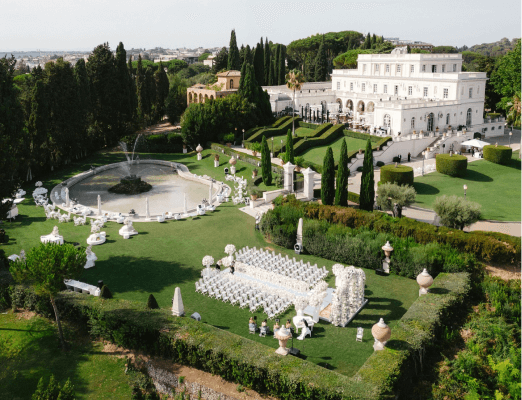
The Oberoi Udaivilas, Udaipur
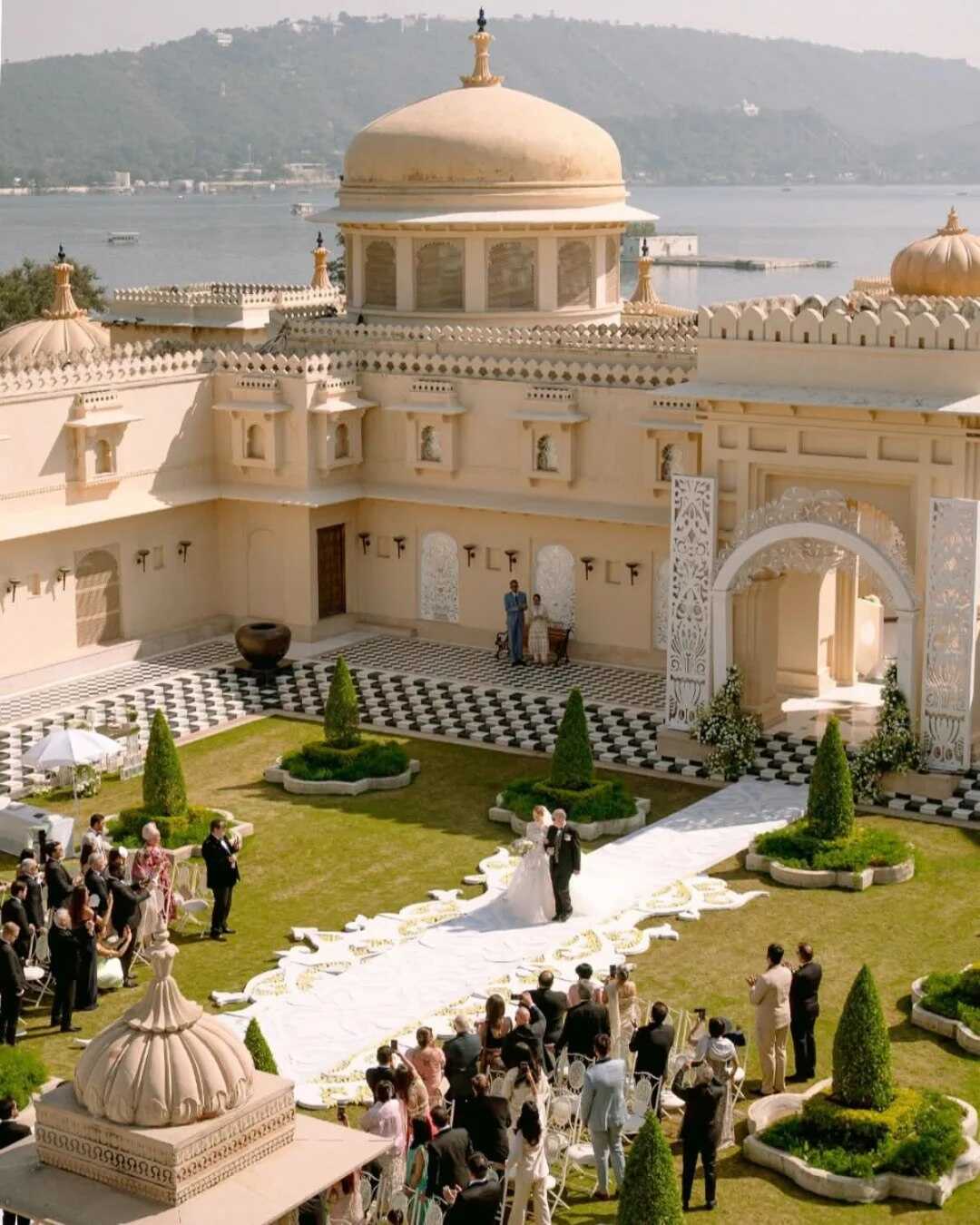
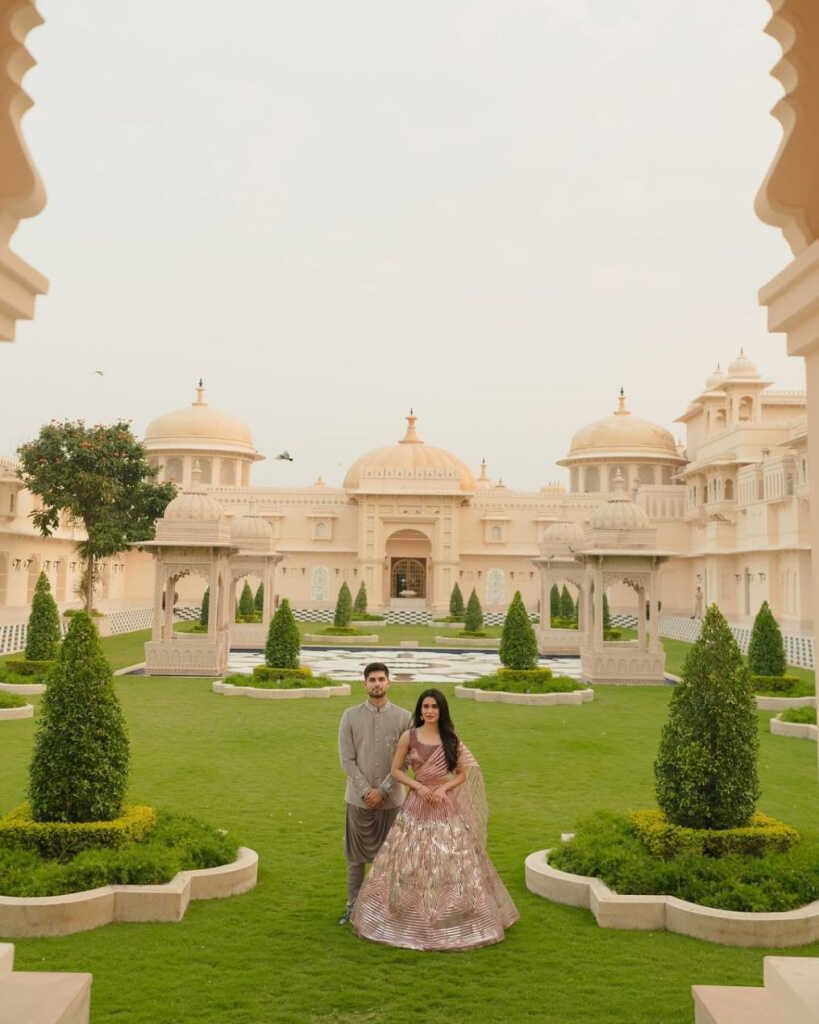
The Oberoi Udaivilas is situated directly on the shore of Lake Pichola, and its architects designed the entire complex - including the domes, corridors, and paths that connect them - to mirror the arrangement of Udaipur, a city in which seven lakes are connected by a system of canals. Spanning 30 acres of gardens, the resort's Crescent Garden can accommodate up to 300 guests, and the property as a whole has a capacity of around 800 people for large-scale events on its lawns and in its banquet areas.
Seven distinct event venues, named Avi, Sulek, Hela, Adhira, Yamir, Maira, and Sohalia, give couples a genuine range of settings within one property, from the intimate Chandra Mahal, which seats around 110 or splits into two smaller halls, to sweeping outdoor lawns with direct views of the City Palace across the water. With 87 rooms and suites, several featuring private pools and garden terraces, the resort was built specifically to let a wedding party stay together on-site rather than scattering across the city.
Umaid Bhawan Palace, Jodhpur
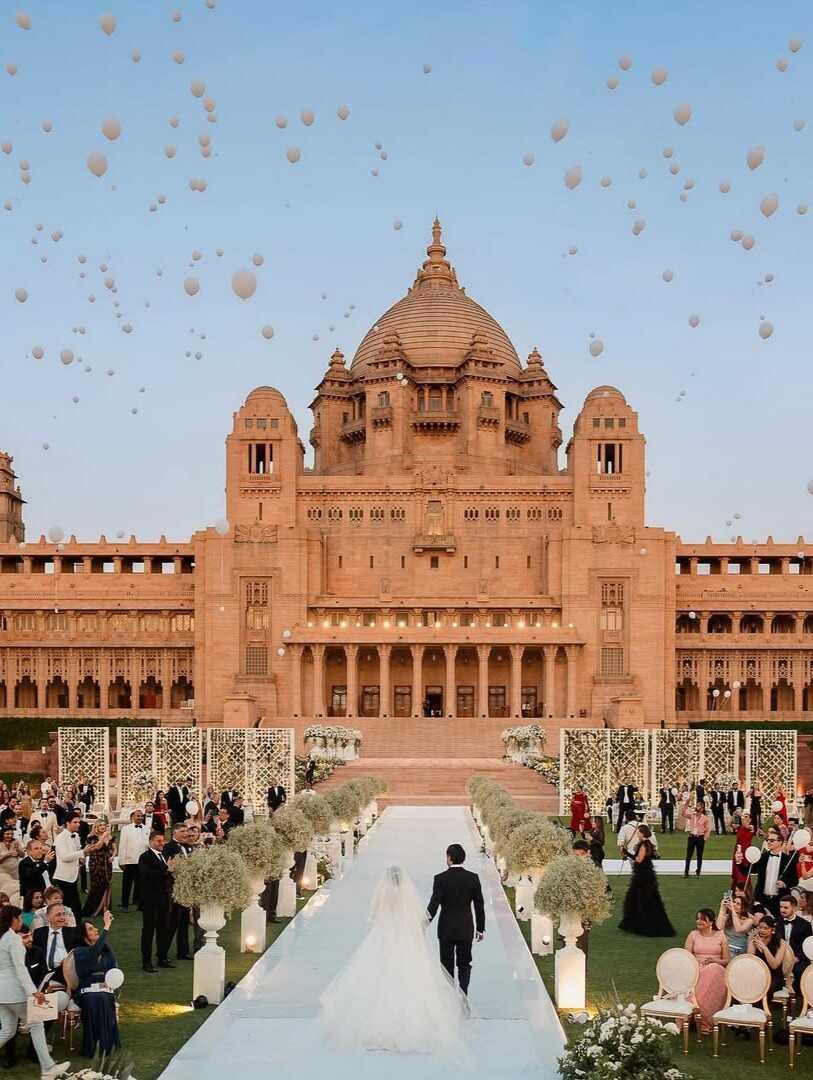
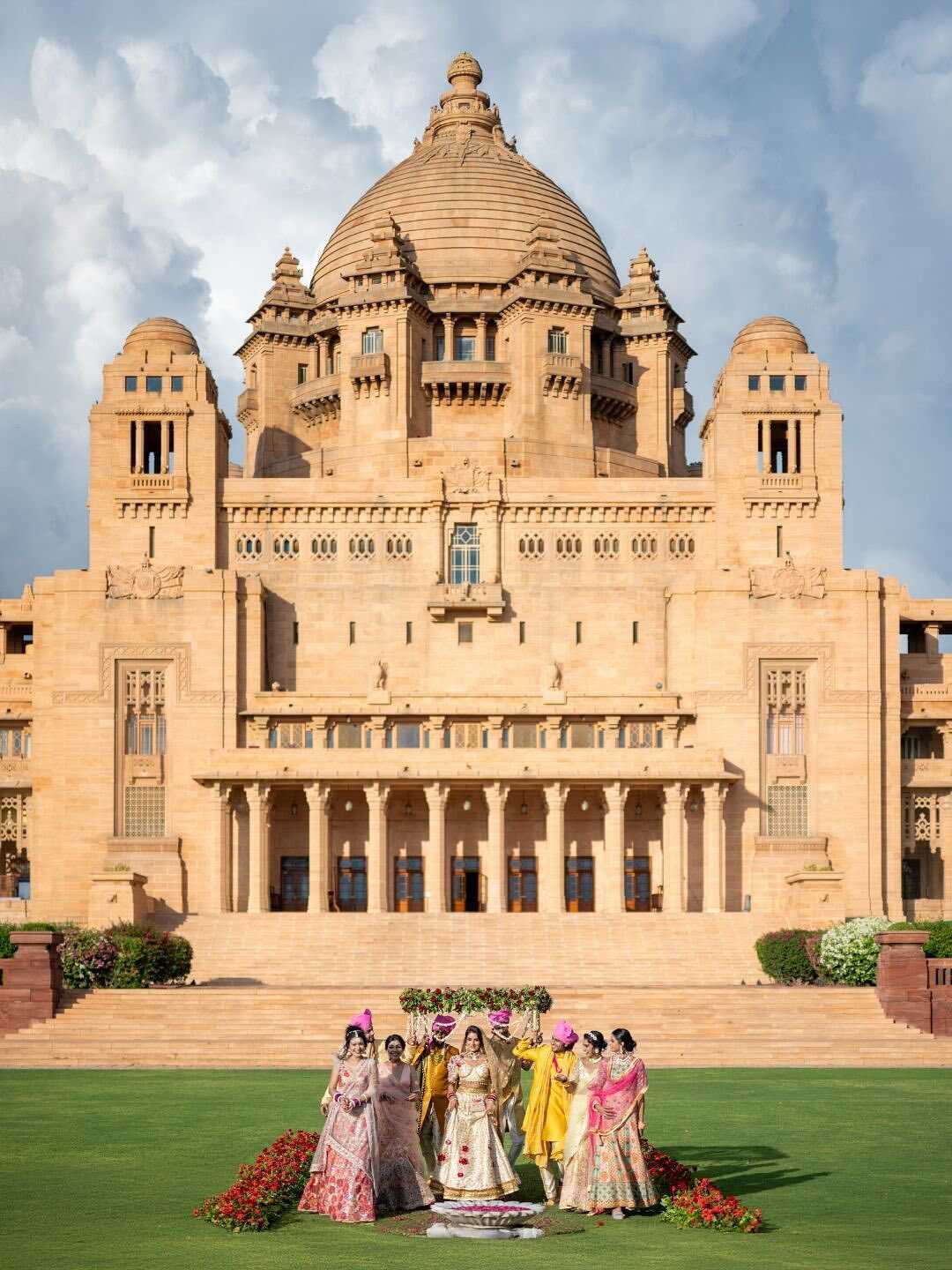
Constructed over a period of fifteen years and finished in 1943, Umaid Bhawan Palace is still one of the largest private houses ever built - it is a golden sandstone structure commissioned to provide employment for farmers suffering from famine at a time when Jodhpur was experiencing a severe drought. Named after Maharaja Umaid Singh, the palace is now used in three capacities: as a working museum, as the private residence of the present royal family, and as a luxury hotel operated by the Taj Group, where the Marwar Hall previously held the Maharaja's private functions, there being the Maharani and her entourage seated on an upper deck while the men were below.
The fact that it has such a layered history is one of the reasons why the palace became the site of one of the decade's most closely watched celebrity weddings - Priyanka Chopra and Nick Jonas got married there in 2018, and among the earlier guests have been Mick Jagger and Prince Charles. The capacity differs greatly depending on the space and its configuration:
| Venue | Setup | Capacity |
|---|---|---|
| Marwar Hall | Theatre-style | Up to 180 |
| Baradari Lawns | Outdoor, full lawn | Up to 750 |
| Full property buyout | Combined indoor/outdoor | Up to 900+ |
The palace, which has 64 rooms and suites classified as Maharani, Maharaja, Royal, and Regal, allows a wedding party to stay in actual royal rooms rather than in ordinary hotel rooms - a point that is mentioned in almost every couple's account of their marriage here.
The Leela Palace Jaipur
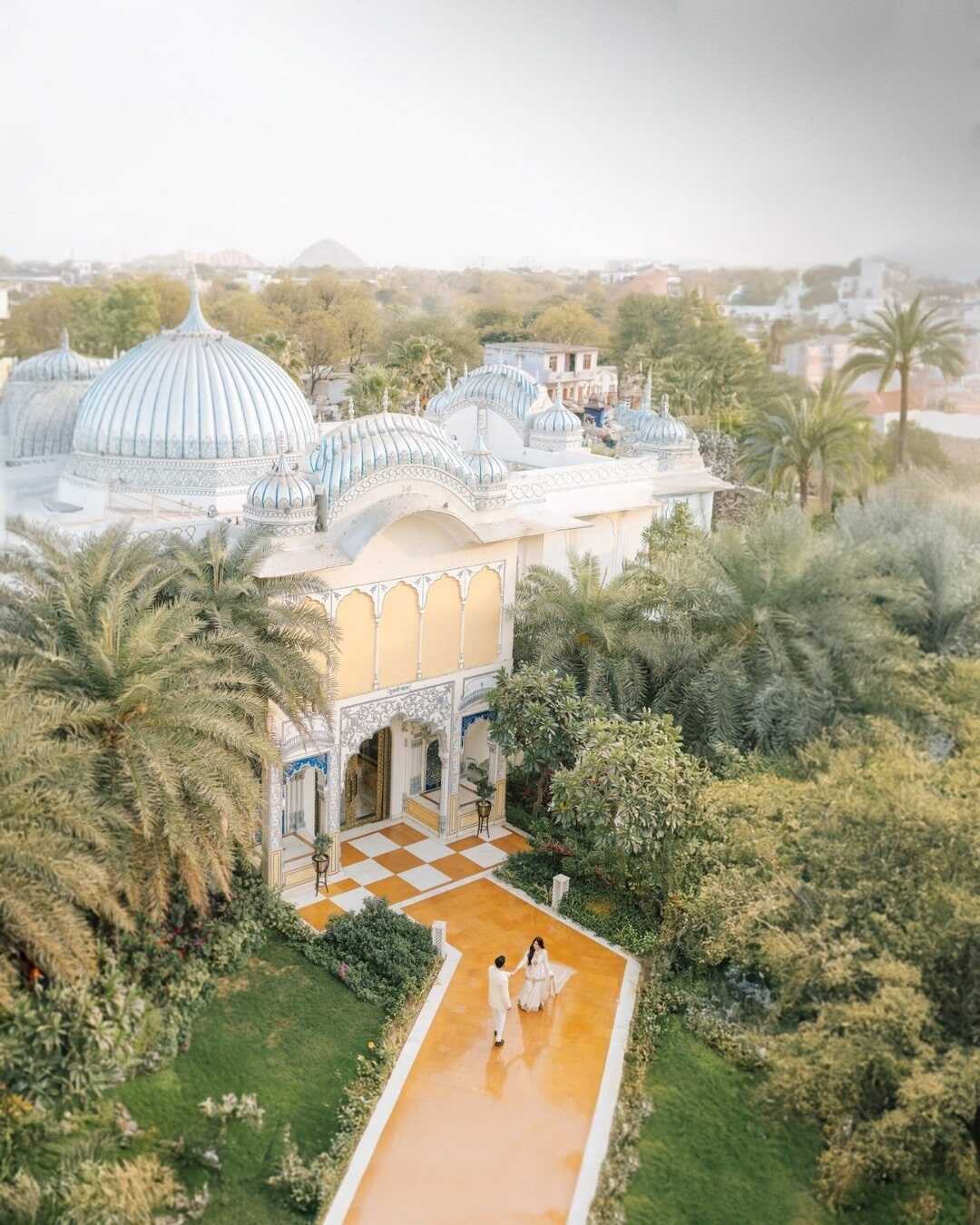
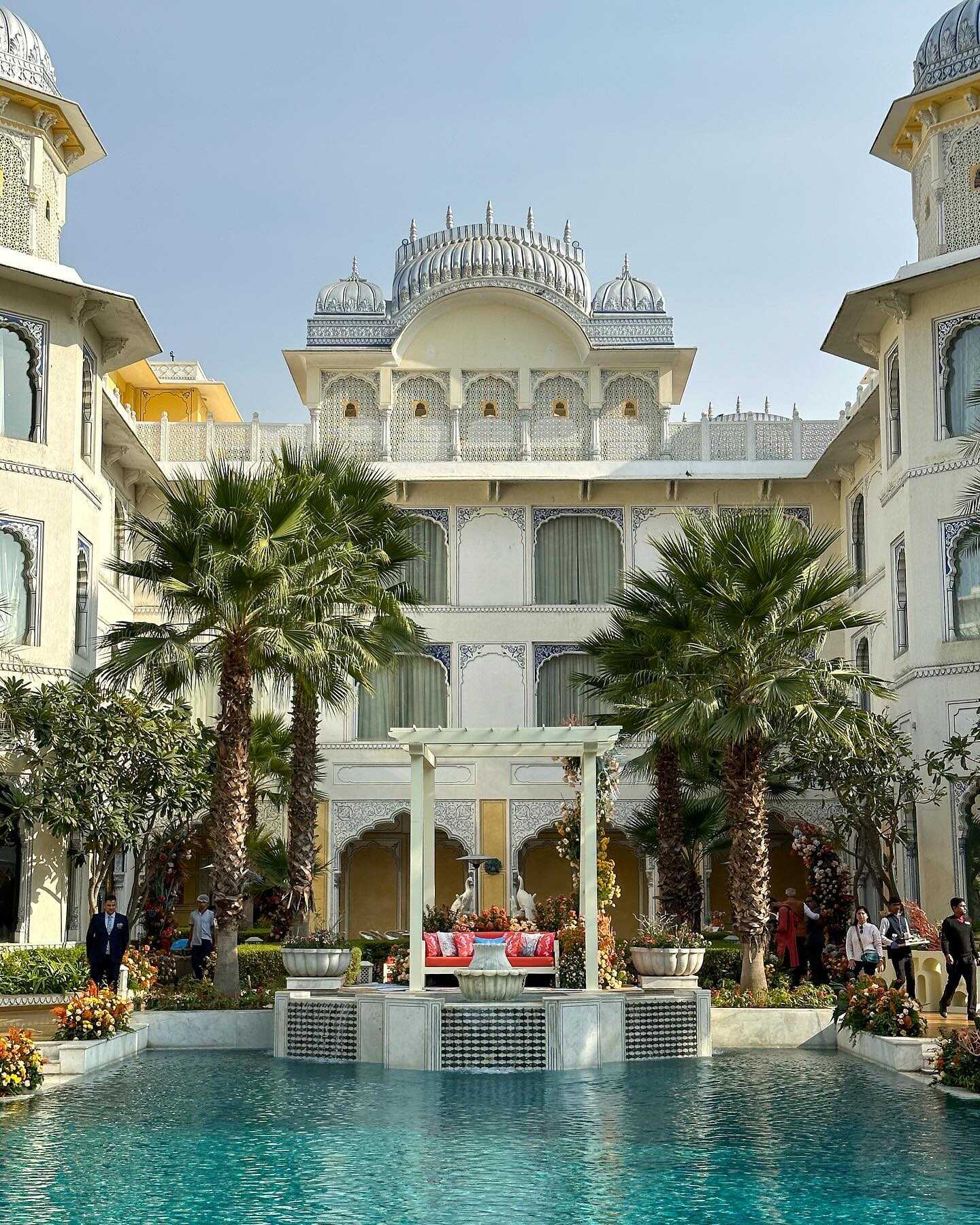
The The Leela Palace Jaipur was designed in the shape of a butterfly and is situated among the Aravalli Hills, covering about 50,000 square feet indoors and outdoors. The Vikram Aditya Grand Ballroom, a hall without columns and measuring nearly 11,000 square feet, can hold up to 800 guests at a seated reception, while the Sundarban Lawn - the property's largest outdoor venue, which exceeds 33,000 square feet - can accommodate 1,600 people for a large celebration under the stars.
The property also features smaller, more private facilities, such as Kanishka Bagh, a landscaped garden suitable for a mehndi or sangeet, and a number of seven individually designed indoor rooms for events that do not require the full scale of the ballroom. Since The Leela Palace Jaipur has 200 rooms and suites, including an Imperial-style Maharaja Suite with a private jacuzzi, the fact that it is the most recent addition to the Leela group's range means its infrastructure has been built to meet the actual requirements of modern destination weddings.
Six Senses Fort Barwara
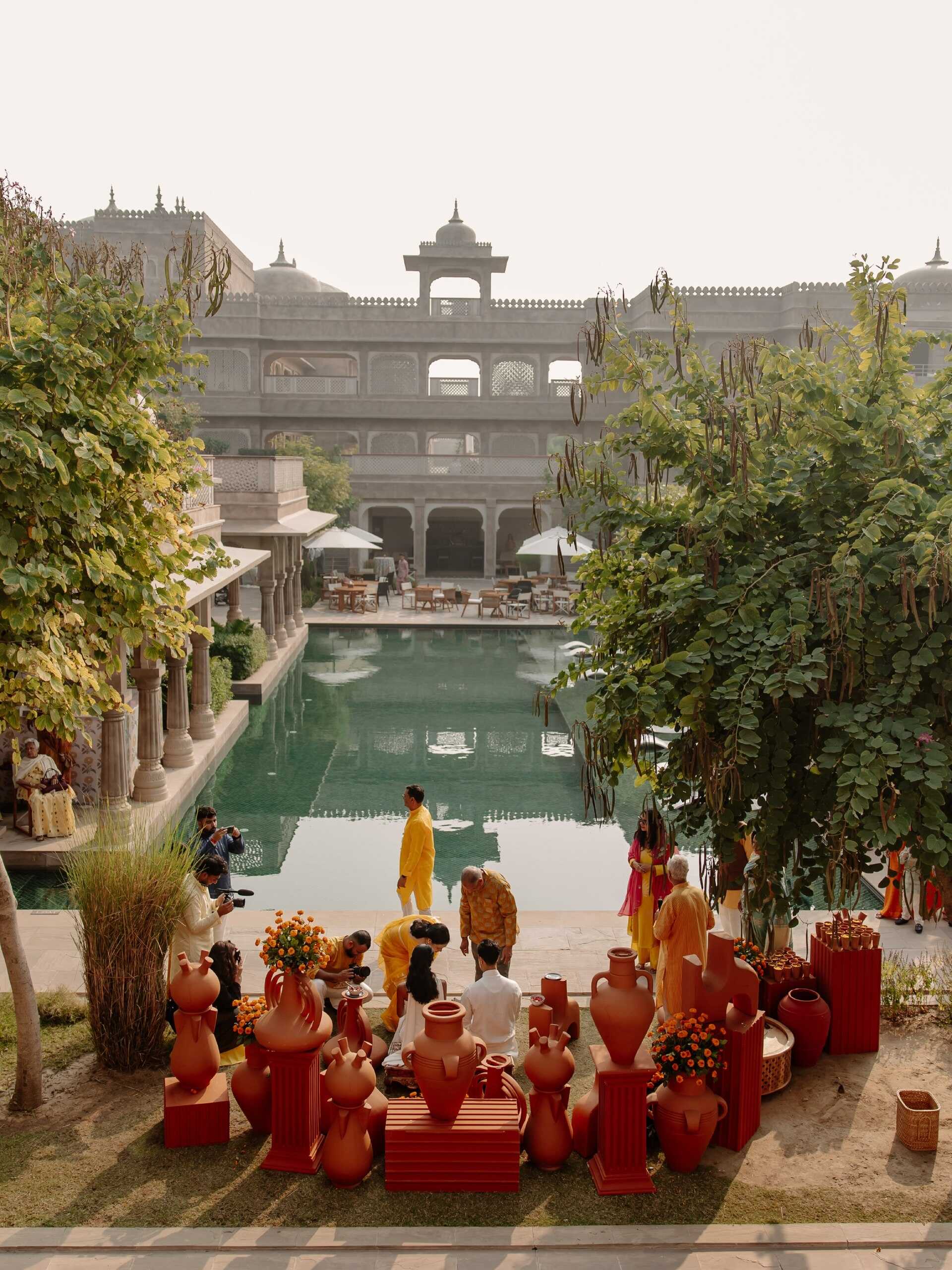
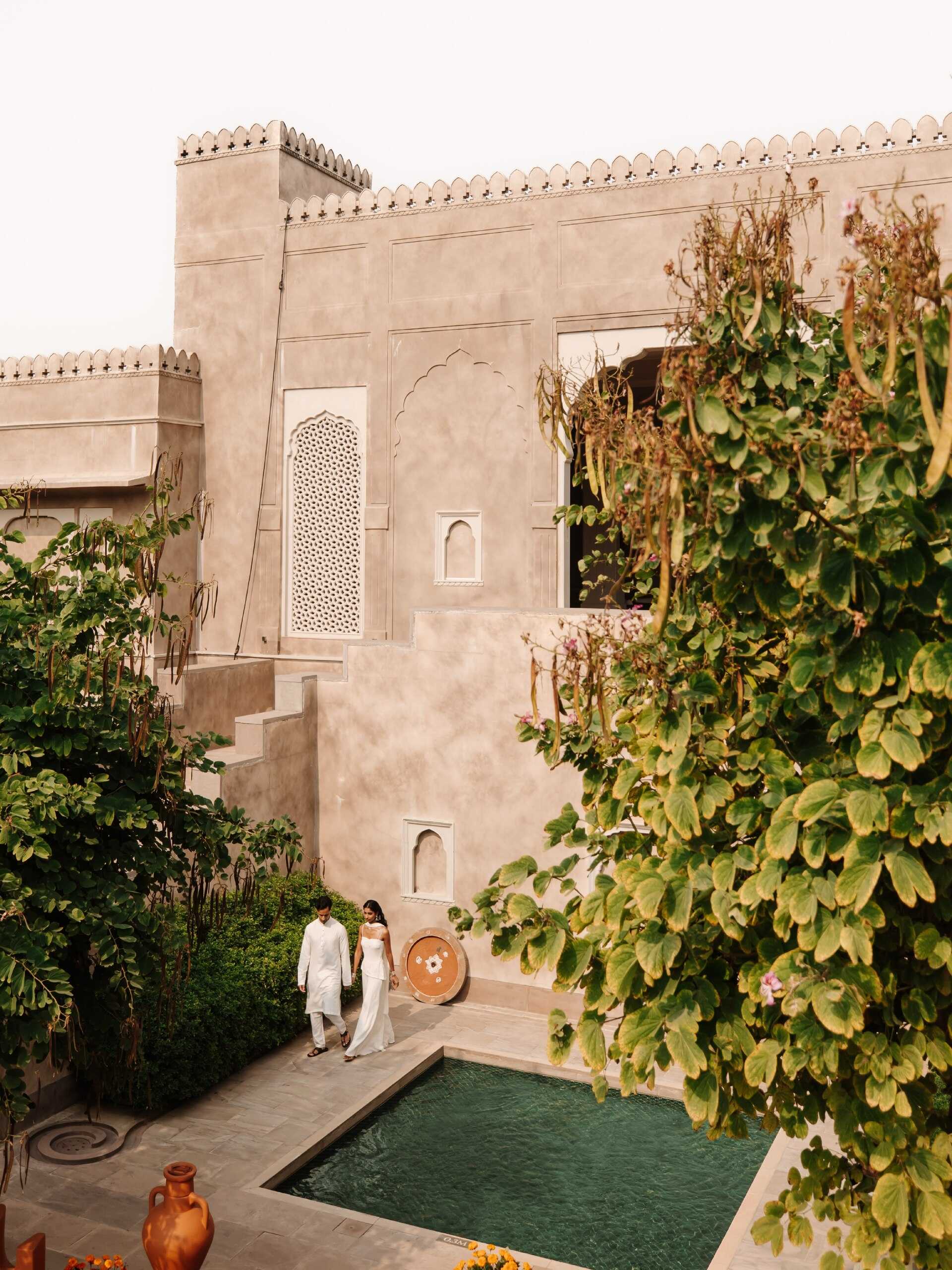
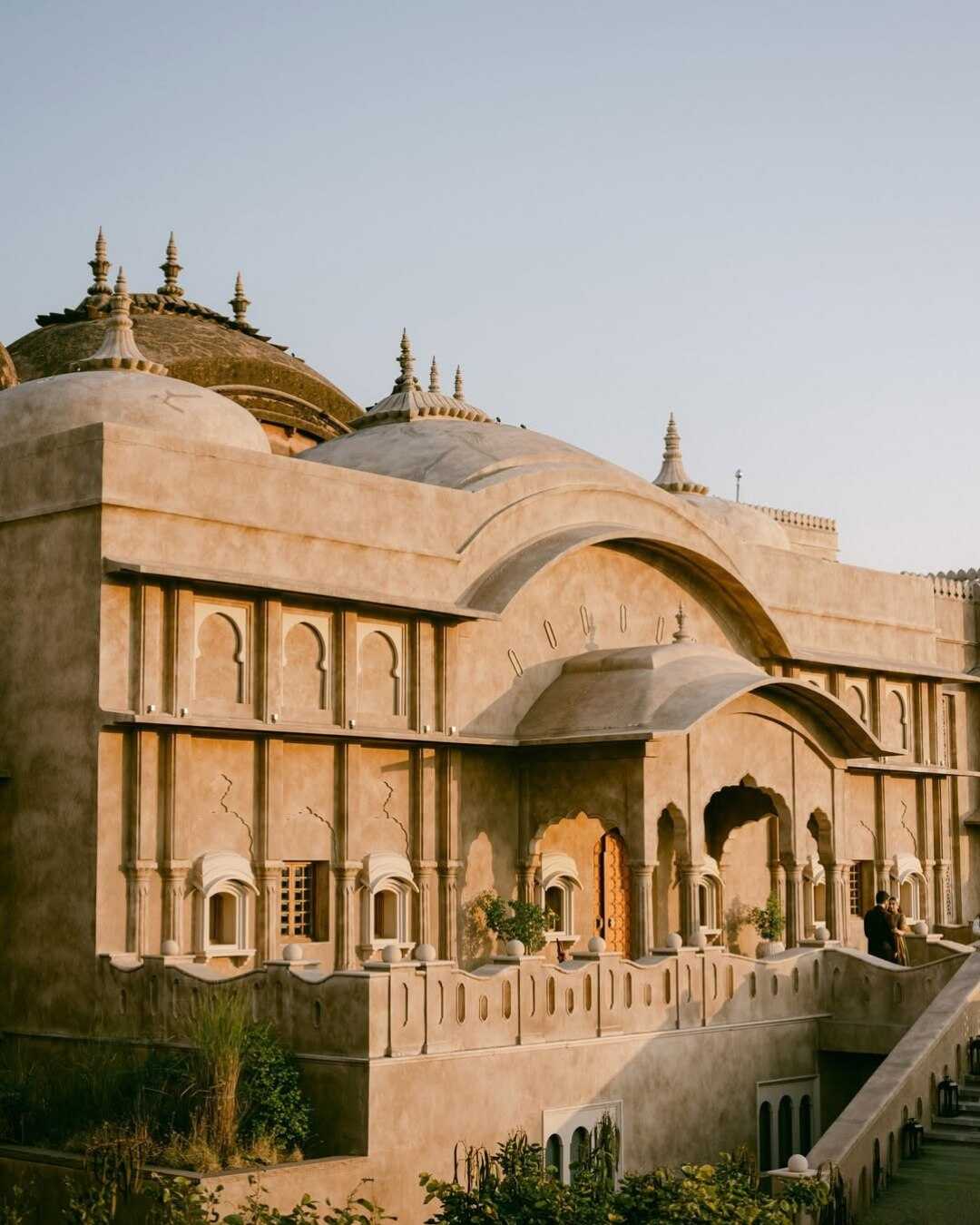
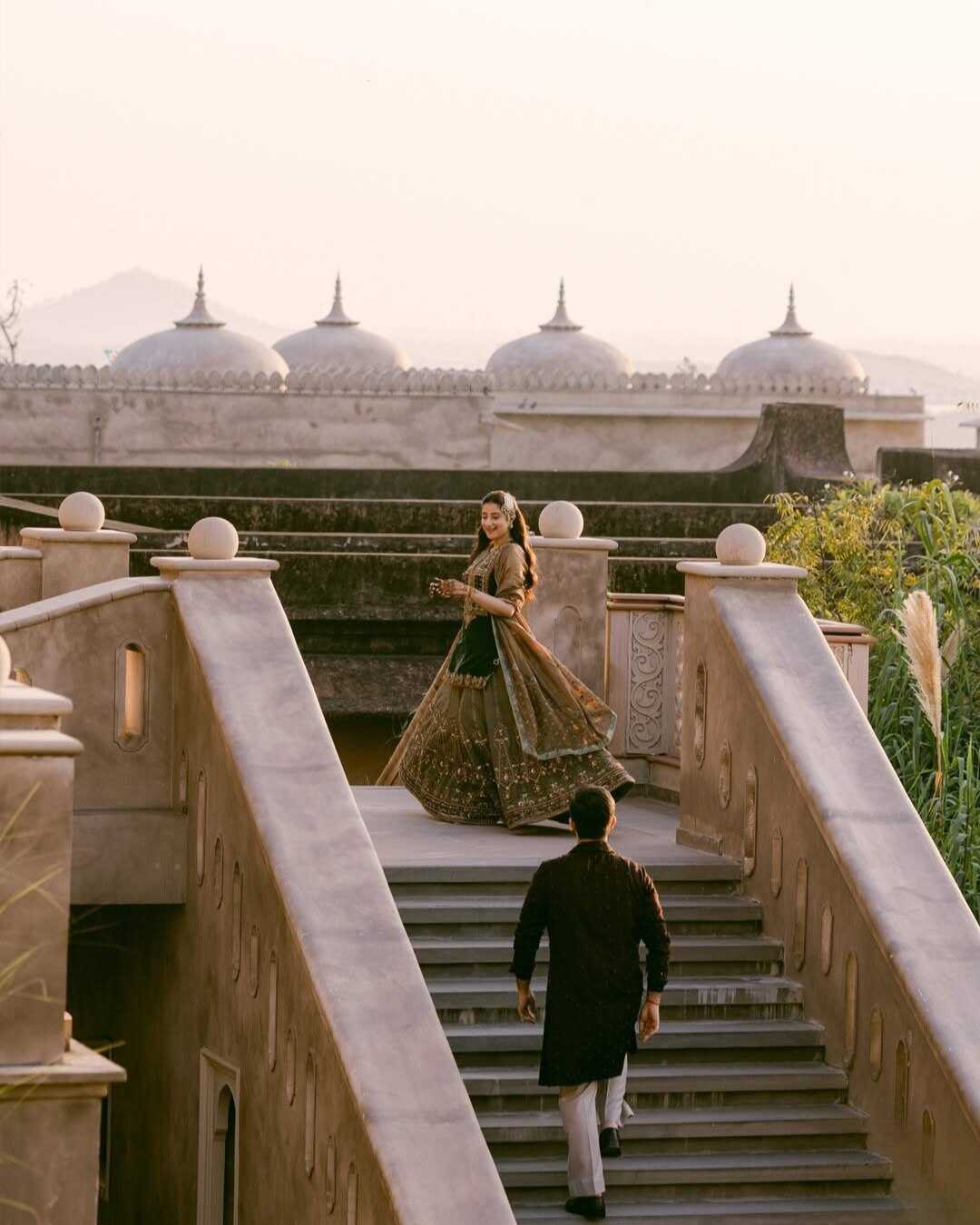
Vicky Kaushal and Katrina Kaif decided to get married at Six Senses Fort Barwara and it's clear why, having regard to the background of the property: the fort, located near Ranthambore and dating back to the 14th century, was originally constructed by the Chauhan dynasty, was then taken over by the Rajawat family in 1734, and remained under restoration for more than ten years before it finally reopened as a luxury hotel in 2021. Within the fort's walls are two original palaces and two functioning temples, one of which is the temple facing the ancient Chauth Ka Barwara Mandir, which is directly opposite the property.
The restoration leaned heavily into sustainability rather than simply preserving appearances - rainwater harvesting and solar panels were installed throughout, and reforestation efforts continue across the surrounding Ranthambore countryside. What guests actually get:
- 48 suites are split across an East Wing overlooking open countryside and a West Wing facing the village
- Capacity for roughly 200 seated guests, or up to 220 in a floating reception format
- Direct proximity to Ranthambore National Park for couples wanting a tiger safari built into the wedding weekend
- A restored temple still active for daily blessings, available to couples who want a ceremony with genuine spiritual continuity
Raas Devigarh Palace, Udaipur
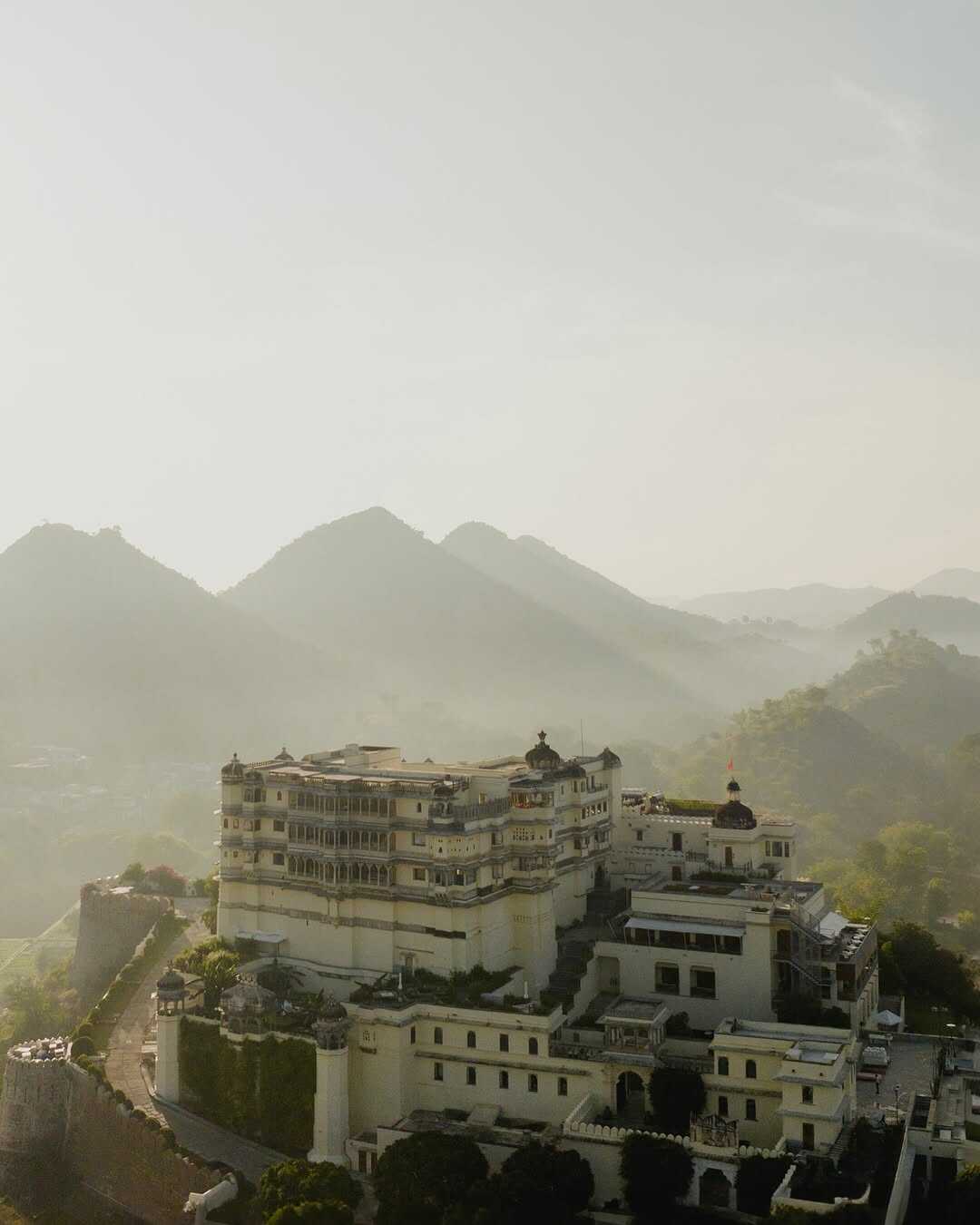
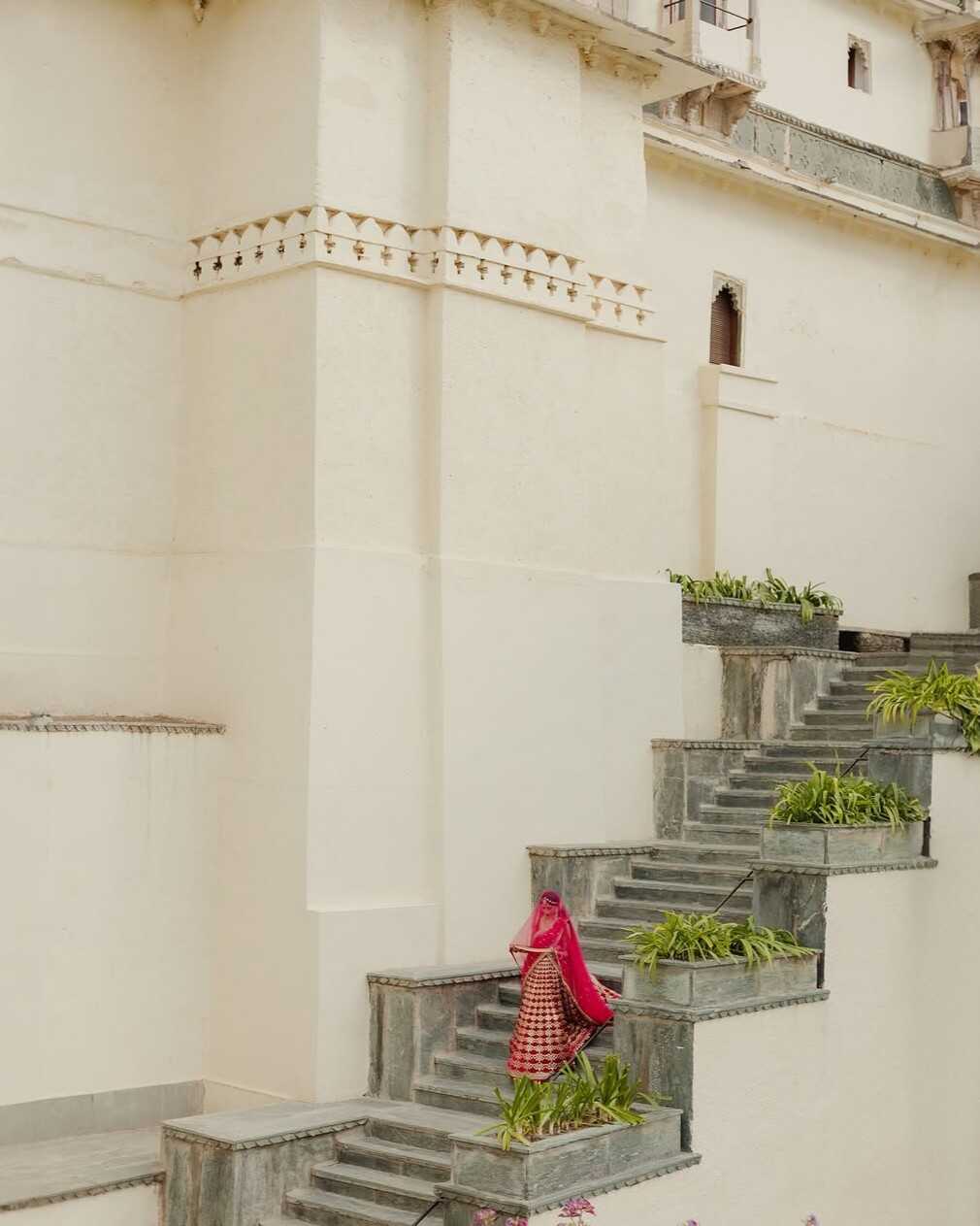
Perched in the Aravalli Hills, about 45 minutes' drive from Udaipur, Raas Devigarh Palace was originally the royal residence of the rulers of the Delwara principality and was finished in 1760 by Rajrana Sajja Singh II, who used marble locally quarried - the same material being used once again during the palace's restoration many years later. What distinguishes this property from other heritage hotels in Rajasthan is the intentional contrast it creates: alongside the intricate stone carvings and jharokhas, there are minimalist marble finishes and mirrored ante-chambers, a combination which the property itself refers to as standing "in two worlds: the traditional and the modern".
The 39 suites of the palace offer views of the village of Delwara below, and its event facilities include a small lawn next to the restaurant, which can accommodate 70-120 guests for a sangeet or other milestone celebration, extending to a full property booking for about 250 people. Because it is near the historic Eklingji Temple, Raas Devigarh is especially suitable for couples who would like to experience Rajasthani grandeur without having to choose a palace wedding that attracts 2,000 guests.

Amanbagh
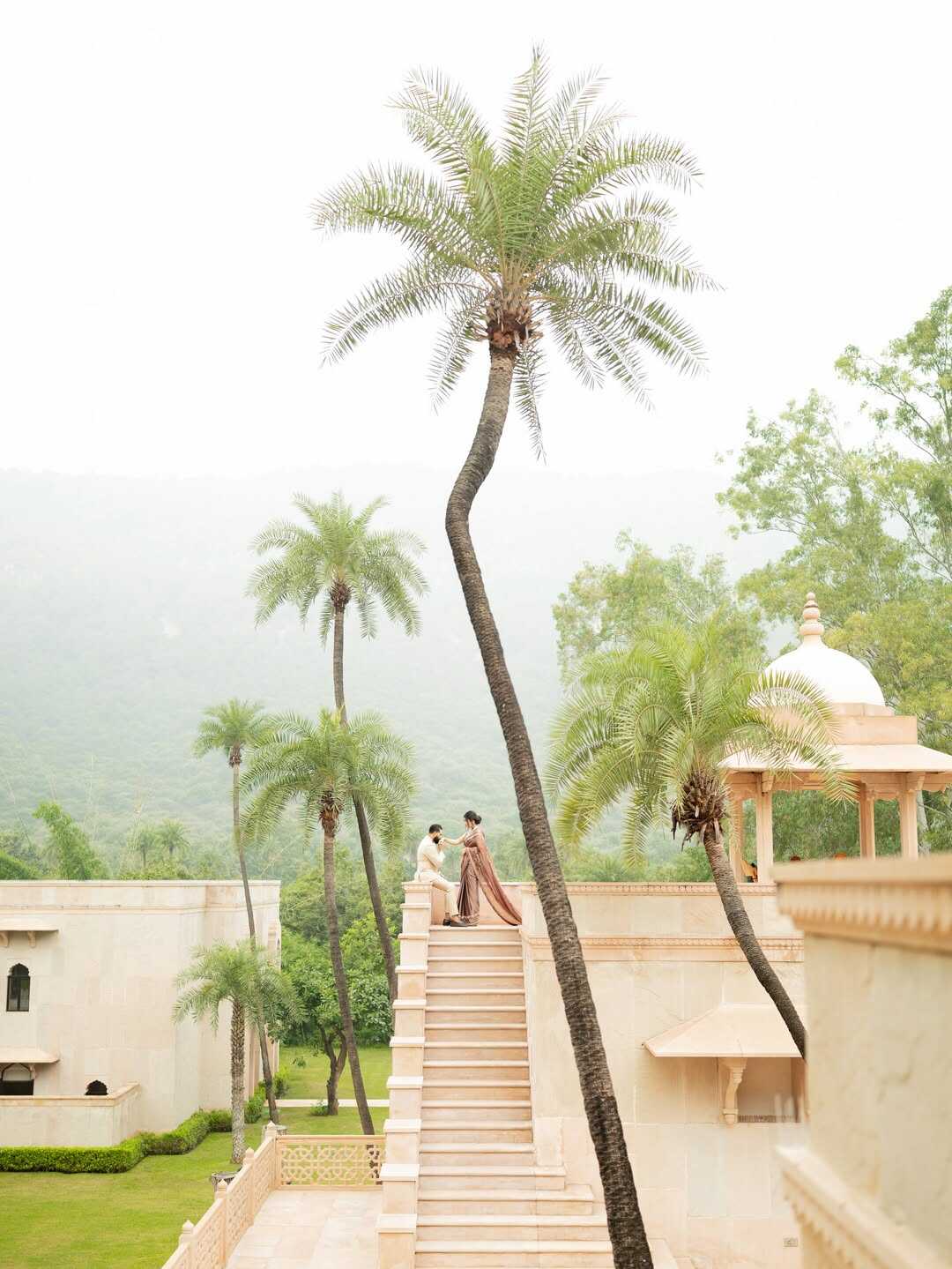
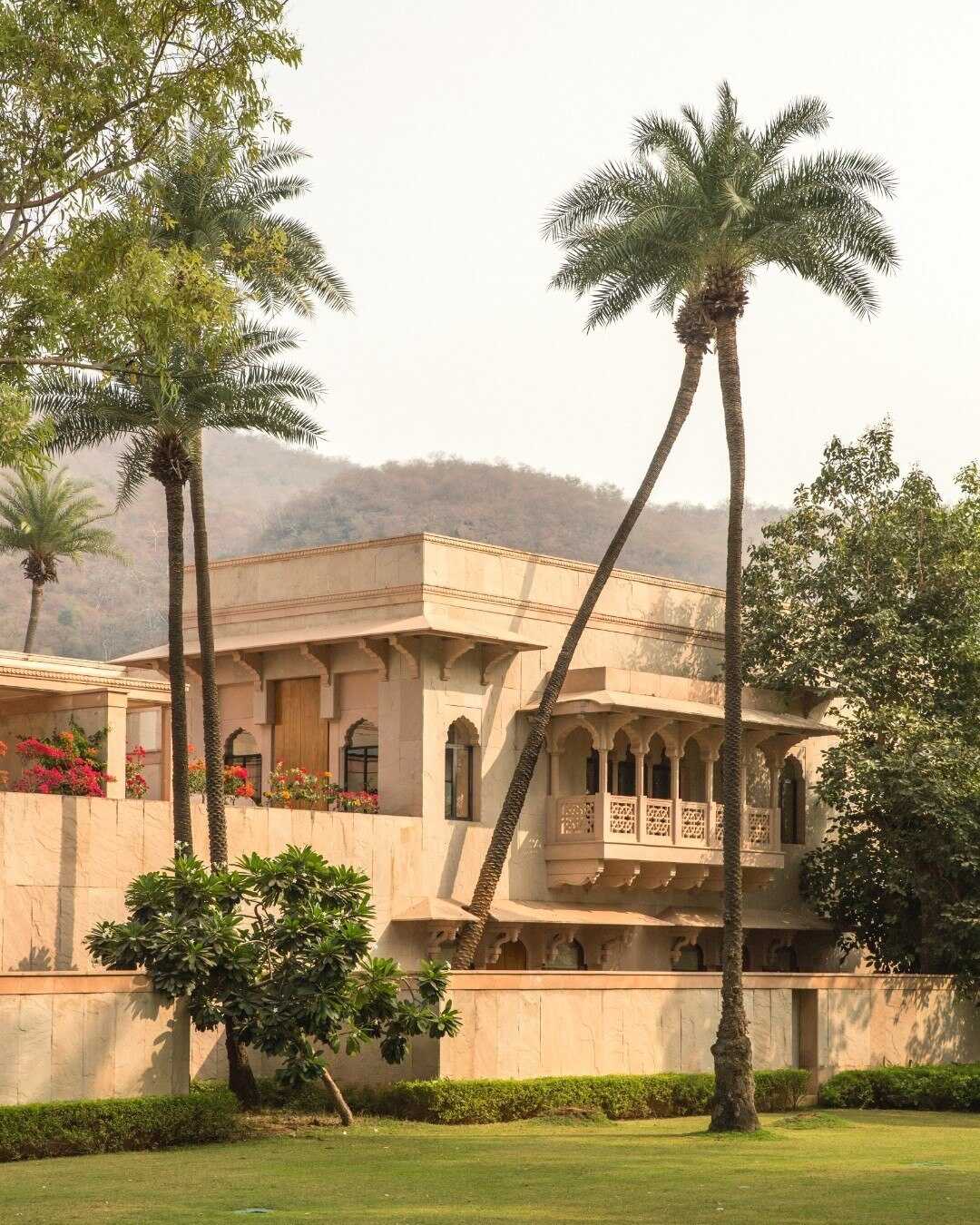
Once the base camp for the Maharajah of Alwar’s tiger-hunting expeditions, Amanbagh has been reimagined as a modern-day Mughal palace carved from local pink marble and sandstone, with scalloped arches and domed cupolas that pay direct homage to India’s Mughal golden age. Set in the Aravalli hills near the ancient ruins of Bhangarh, roughly 90 minutes from Jaipur, the resort backs onto Sariska National Park and remains shaded by mature palm, fruit, and eucalyptus trees planted around its central pool.
Unlike the larger palace hotels on this list, Amanbagh deliberately caps its scale:
- 37 suites total, with a full property buyout accommodating around 78 to 100 guests
- Ceremony and reception spaces built for intimacy rather than volume - no space here is designed to feel like a convention hall
- An organic, Ayurvedic kitchen garden supplying much of the resort’s own produce
- Recommended vendors for photography, florals, and entertainment curated directly by the resort’s own events team
For couples who prefer the subtle luxury of the Aman brand over a grand, lavish palace wedding, Amanbagh remains one of the few properties on this list built specifically around restraint rather than scale. Nothing here is designed to impress a crowd - every detail, from the size of the suites to the length of the guest list, is calibrated for a wedding that stays quiet and personal rather than turning into a spectacle.
Samode Hotel, Jaipur
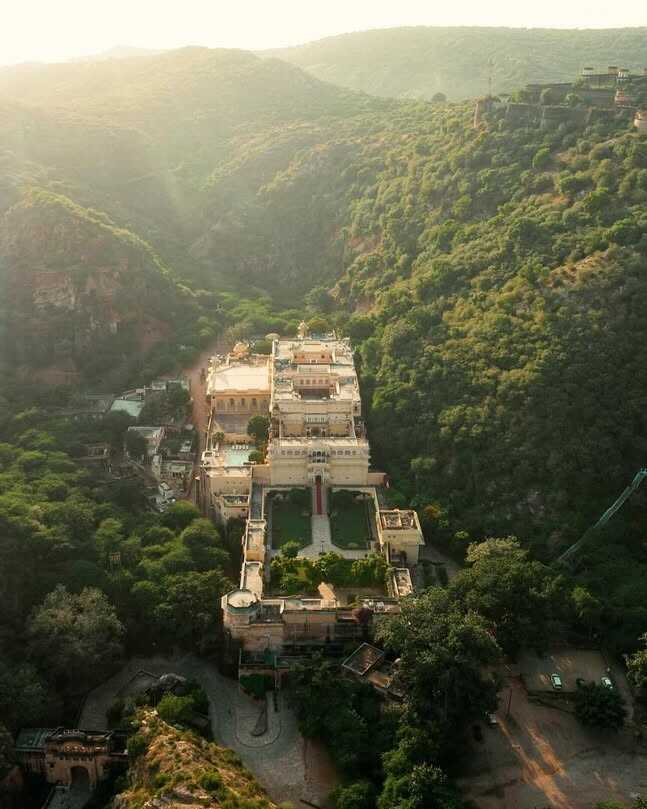
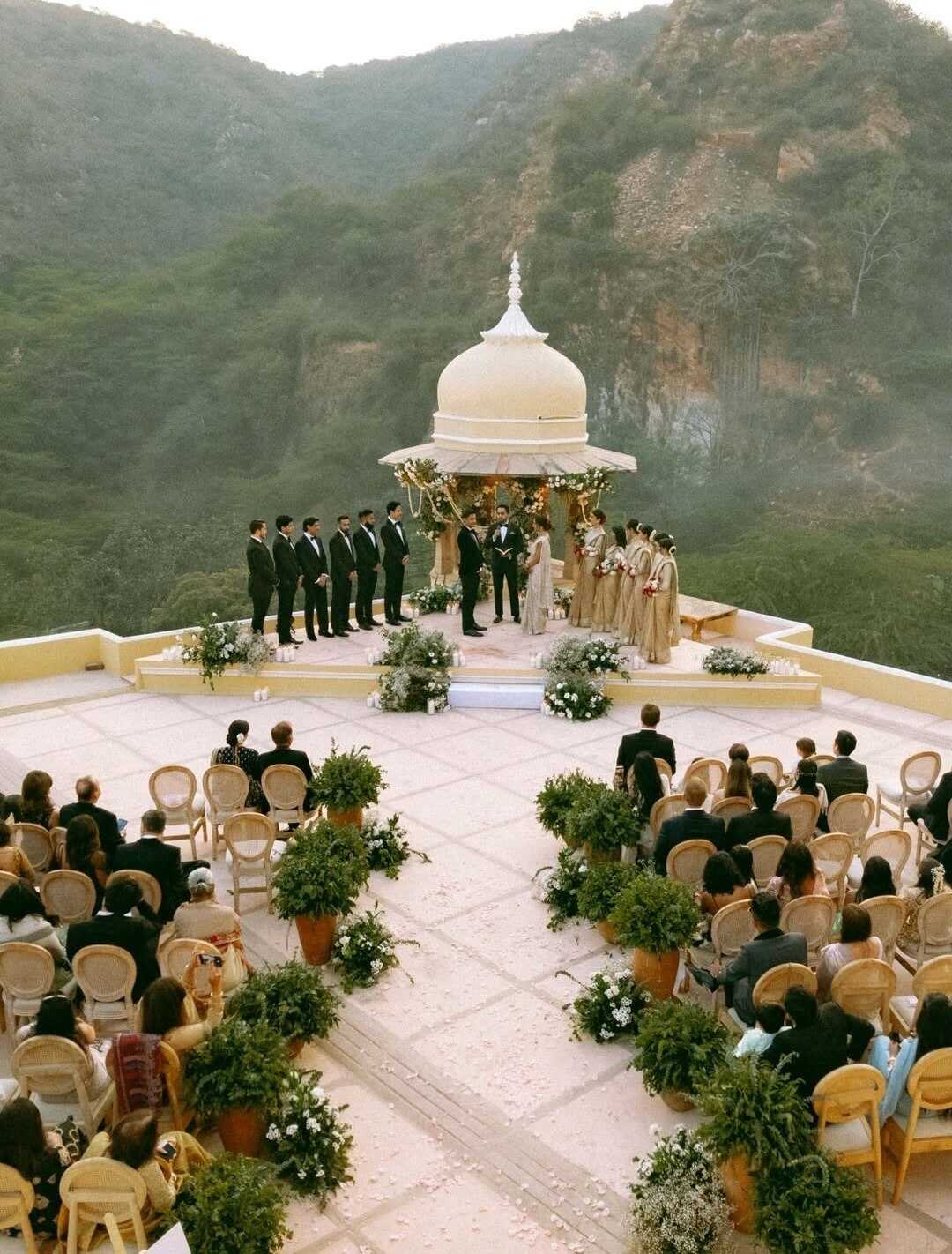
Constructed roughly 475 years ago as a Rajput fort and gradually redesigned into its current Indo-Saracenic form by the 19th century, Samode Palace has never changed hands outside the Samode family, who converted it into a heritage hotel while continuing to maintain it as their own legacy property. The palace’s Sheesh Mahal - its Hall of Mirrors - remains one of Rajasthan’s most photographed interiors, its ornamented pillars and mirrored surfaces reflecting frescoes and murals that in places date back over 250 years.
The Darbar Hall, featuring hand-painted artwork, can accommodate up to 150 guests for a formal indoor event; the central courtyard can hold 2,000 people for a large celebration; and the property's lawns are suitable for receptions with 200-250 guests. Since there are 43 suites within the palace, Samode also has a connection with Samode Bagh adjacent to it, enabling couples to use both properties and thus organize celebrations for a total of around 250 guests.
Rambagh Palace, Jaipur
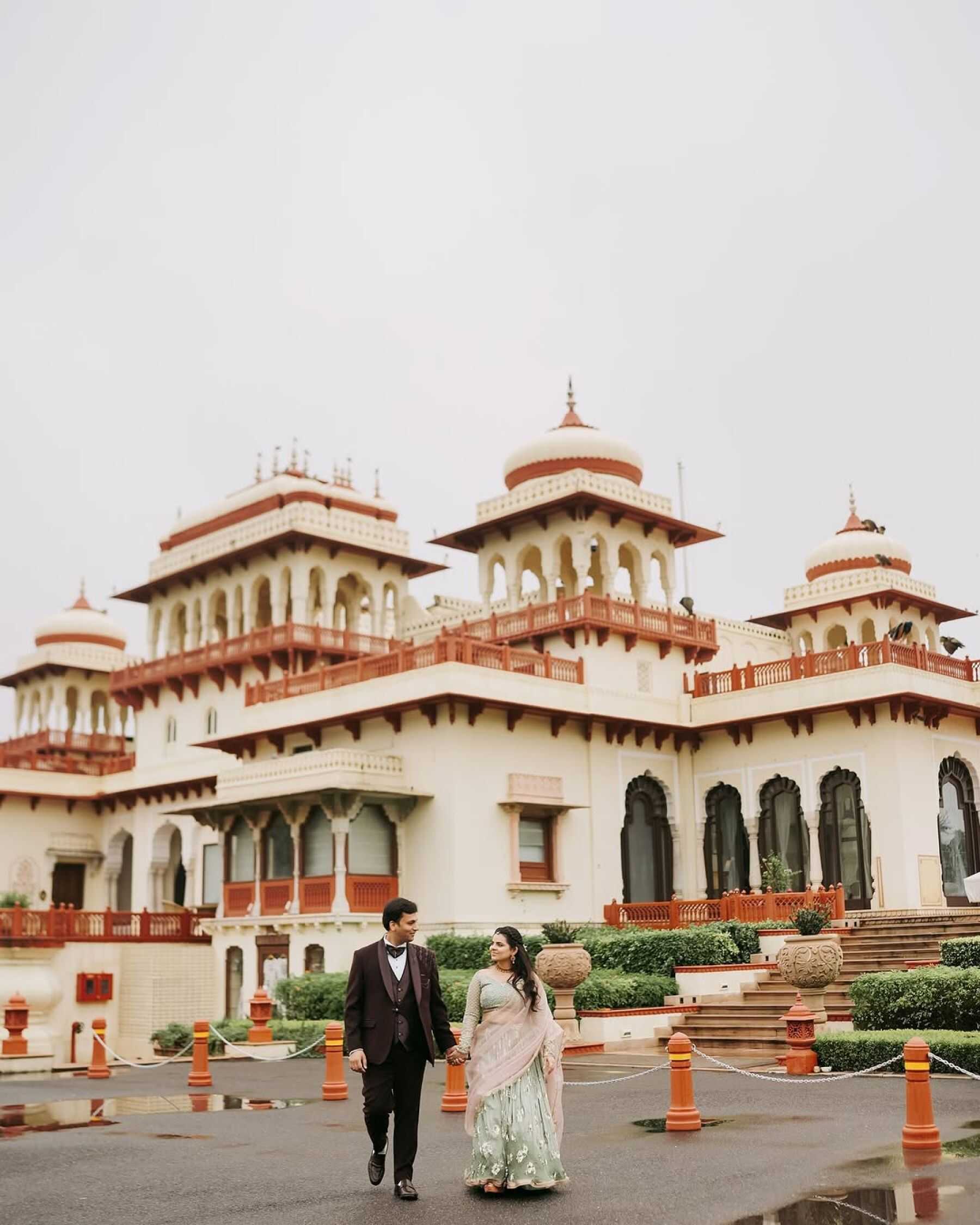
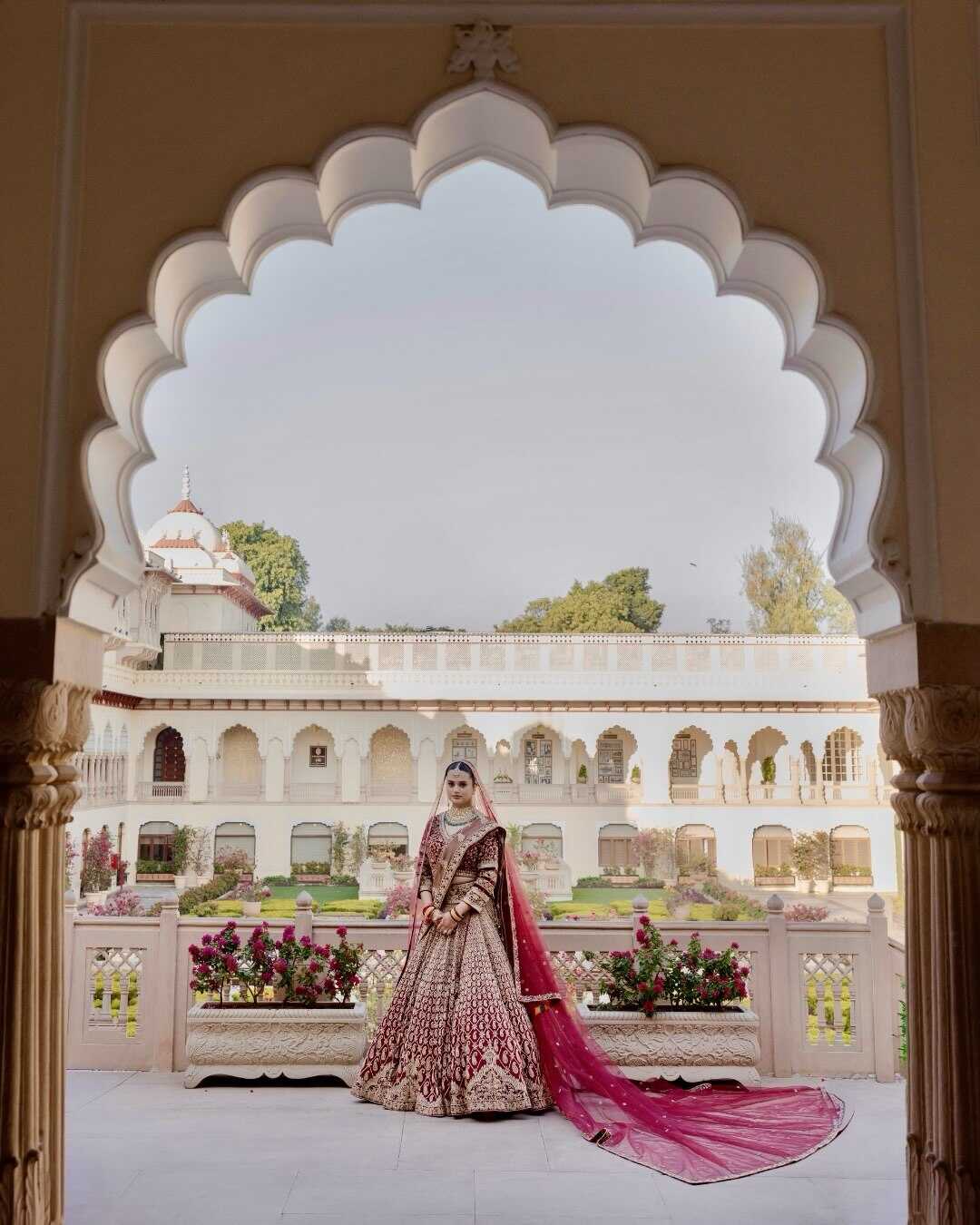
Rambagh Palace started in 1835 as a modest garden house built for the wet nurse of Prince Ram Singh II, and over the following century, it evolved into a British Residency, a royal hunting lodge, and finally, by 1925, the primary residence of Maharaja Sawai Man Singh II and his celebrated queen, Maharani Gayatri Devi. Converted into India’s first true luxury palace hotel after independence and taken over by Taj Hotels in 1972, “the Jewel of Jaipur” has hosted Jacqueline Kennedy, Lord Mountbatten, and Queen Elizabeth II across its 47 acres of manicured Mughal gardens.
Today, the site features more than ten distinct heritage event spaces, with its hand-carved marble jalis and sandstone cenotaphs forming the backdrop, among them the famous Naksha Garden and a Panghat Lawn that surrounds a pavilion and an amphitheater. The Naksha Lawn can accommodate 2,000 guests, and with the 78 rooms and suites - some of which had previously served as the Maharaja's private chambers - a wedding party can sleep within real royal history rather than in a themed imitation of it.
Taj Lake Palace, Udaipur
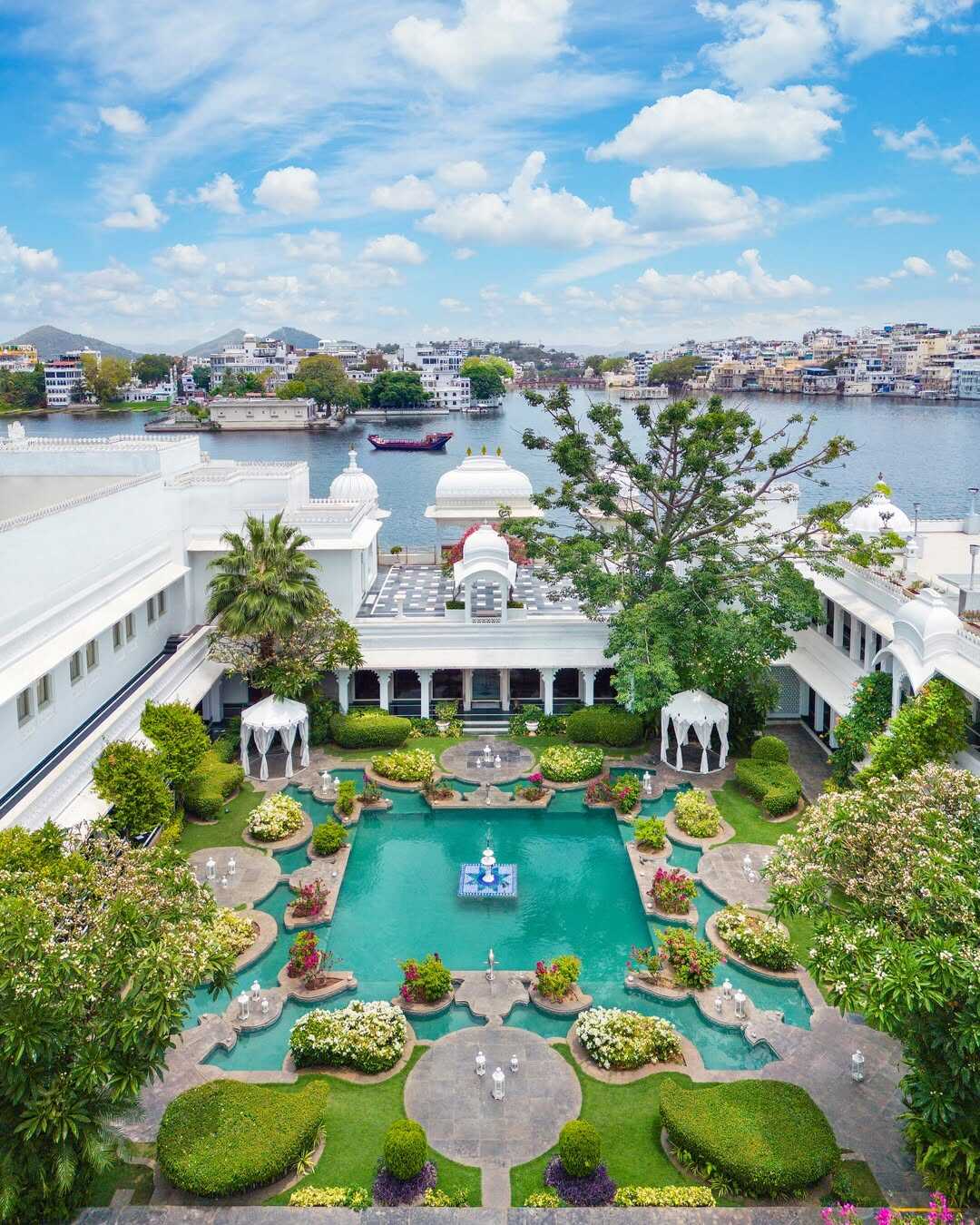
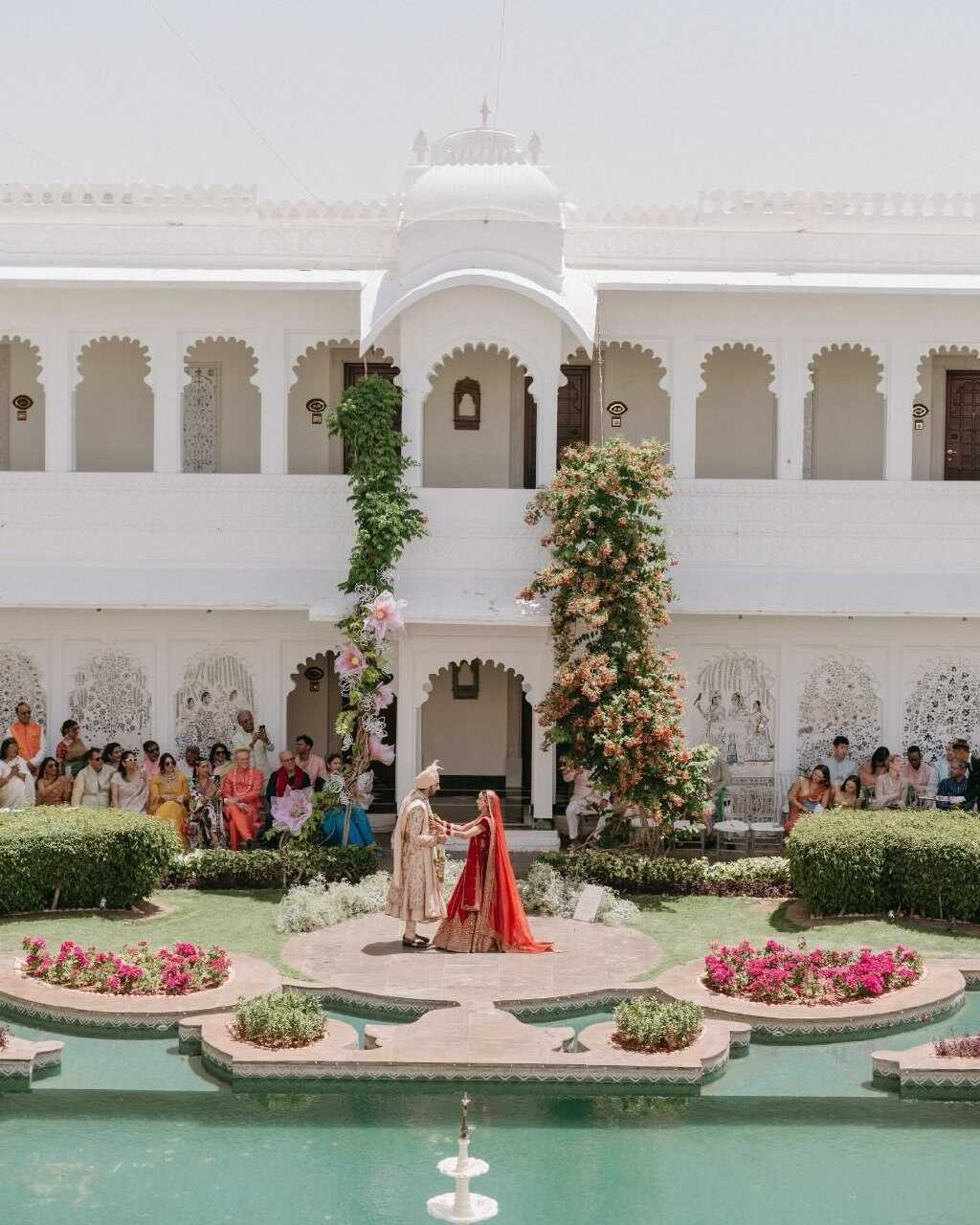
At first called Jag Niwas and commissioned by Maharana Jagat Singh II as a private pleasure palace, the Taj Lake Palace, Udaipur has been situated on Lake Pichola since 1746 and is therefore one of the very few wedding venues in the world that can be reached exclusively by boat, meaning each guest's arrival becomes part of the ceremony itself. The palace is entirely carved from white marble, with elaborate inlay work, and features lotus ponds and courtyards filled with bougainvillea and jasmine. It is located on its own natural island, with views of the Aravalli hills and Udaipur's City Palace.
With only 65 to 83 rooms and suites, depending on configuration, the property is built around intimacy by design - most couples cap guest counts between 80 and 200, and a full buyout turns the entire floating palace into private space for a single wedding. Terraces and courtyards host the bulk of ceremonies, with heritage indoor halls serving as elegant weather backup during India’s monsoon season.
Raffles Udaipur
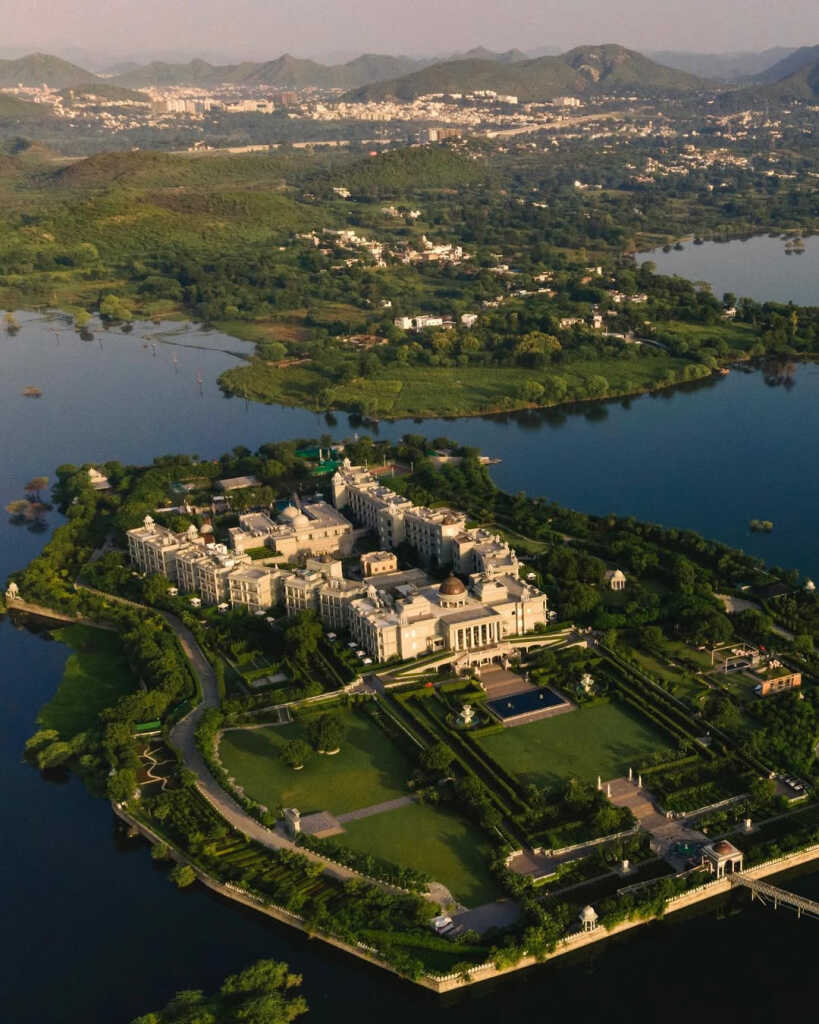
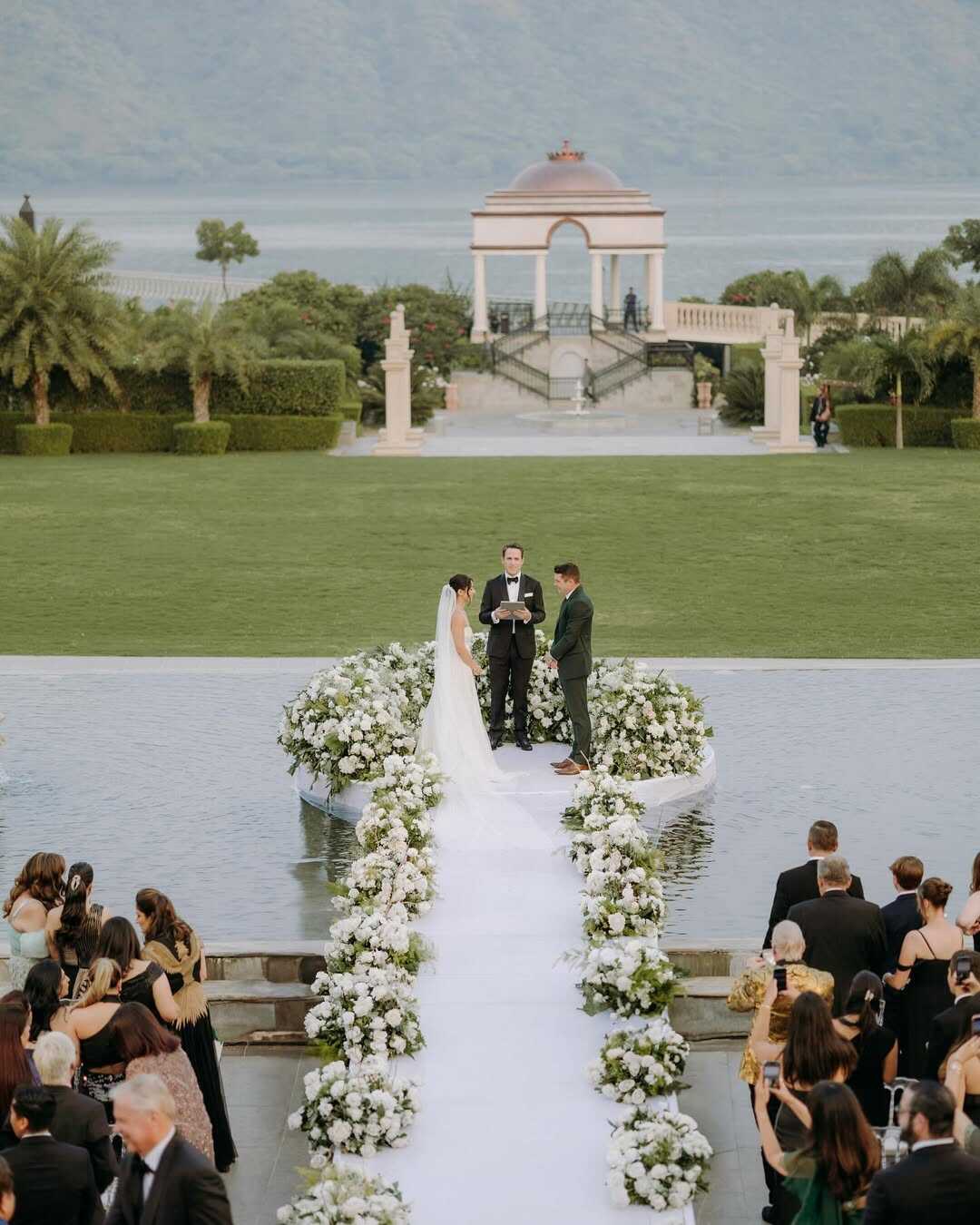
Guests can reach Raffles Udaipur by taking a 10-minute boat trip from the mainland; the resort is located on a private island in Udai Sagar Lake, rather than in the more well-known Lake Pichola, which is preferred by its neighboring properties. The resort's garden temple is directly inspired by a real 400-year-old Mahadev temple situated high in the Aravalli Hills and has been reimagined here as a peaceful ceremony space with views of the water.
Event spaces at Raffles Udaipur scale dramatically depending on format:
- Event Lawn: 800 to 1,000 guests, the property’s largest outdoor space
- Party Lawn: 400 to 500 guests, suited to a sangeet or reception
- Poolside Lawn: 200 to 300 guests, ideal for a cocktail evening or smaller ceremony
- Raja’s Hunting Lawn: 300 to 400 guests, named for the estate’s royal hunting history
- Indoor Ballroom + courtyard combination: 300 to 350 guests, the weather-contingency option
Raffles Udaipur, which has 136 or 137 rooms and features Indo-Saracenic architecture throughout, has rapidly become one of the city's most exclusive island hotels, even though it is a much more recent entry into Udaipur's wedding market than its palace-hotel neighbors.
Alila Fort Bishangarh, Jaipur
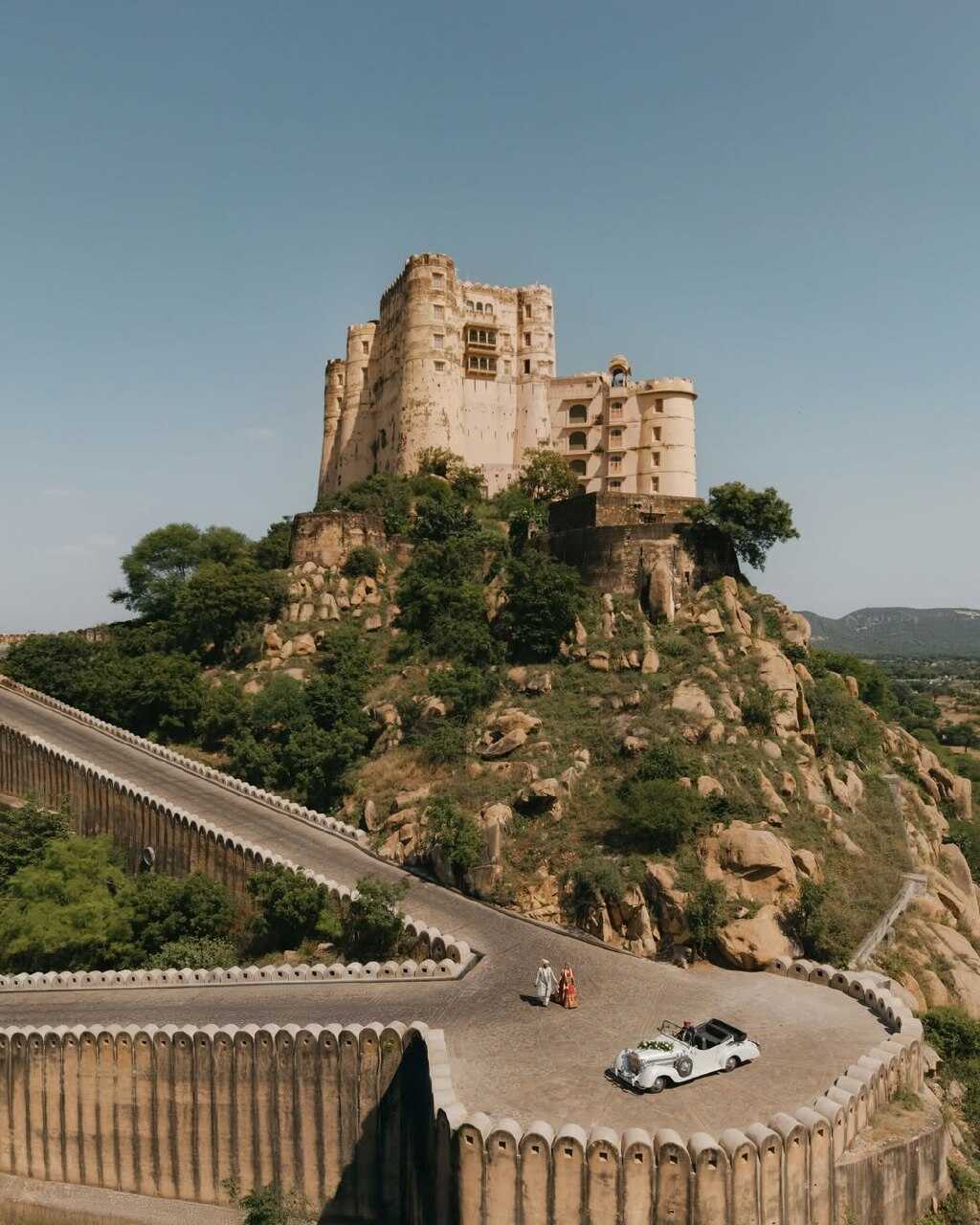
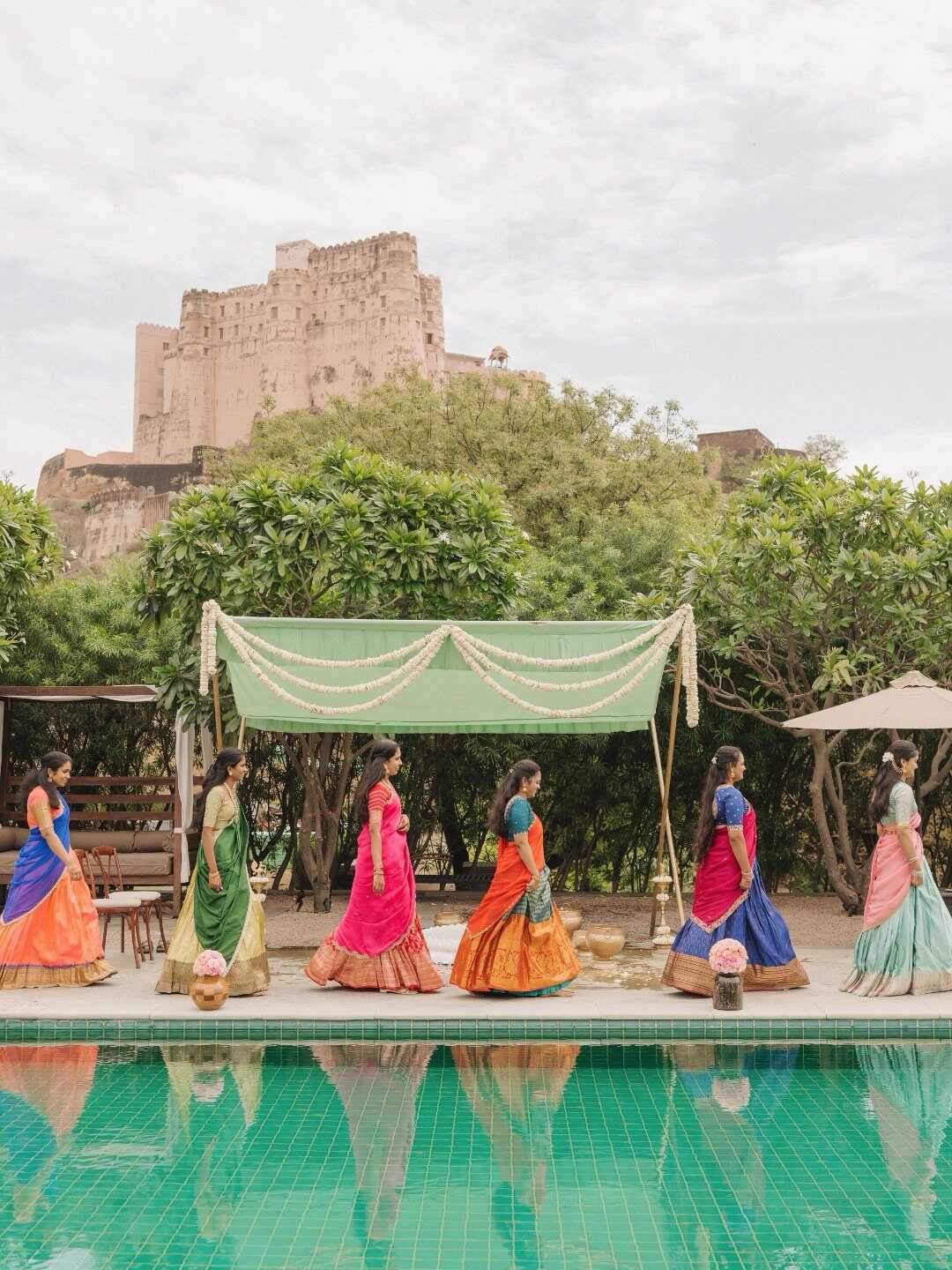
Situated on a granite hill within the Aravalli range, Alila Fort Bishangarh is a true fortress of 230 years' standing, with its massive sandstone walls, hidden passages, and isolated hilltop location left mostly unchanged. It was here that actress Aditi Rao Hydari married Siddharth, since the fort's atmosphere reminded her of her childhood home - a fact that perfectly illustrates why couples prefer this property to the bigger, more conventional palace hotels in Jaipur.
The fort, with 59 rooms and suites and 15 event spaces in its original courtyards and terraces, usually arranges full-property bookings for 100-200 guests rather than large-scale celebrations. The unique architectural style of Jaipur Gharana - which combines Mughal and British colonial elements - gives each ceremony space a real, centuries-old, inhabited atmosphere that more modern heritage-style resorts can only manage to copy.
Wyndham Garden Udaipur
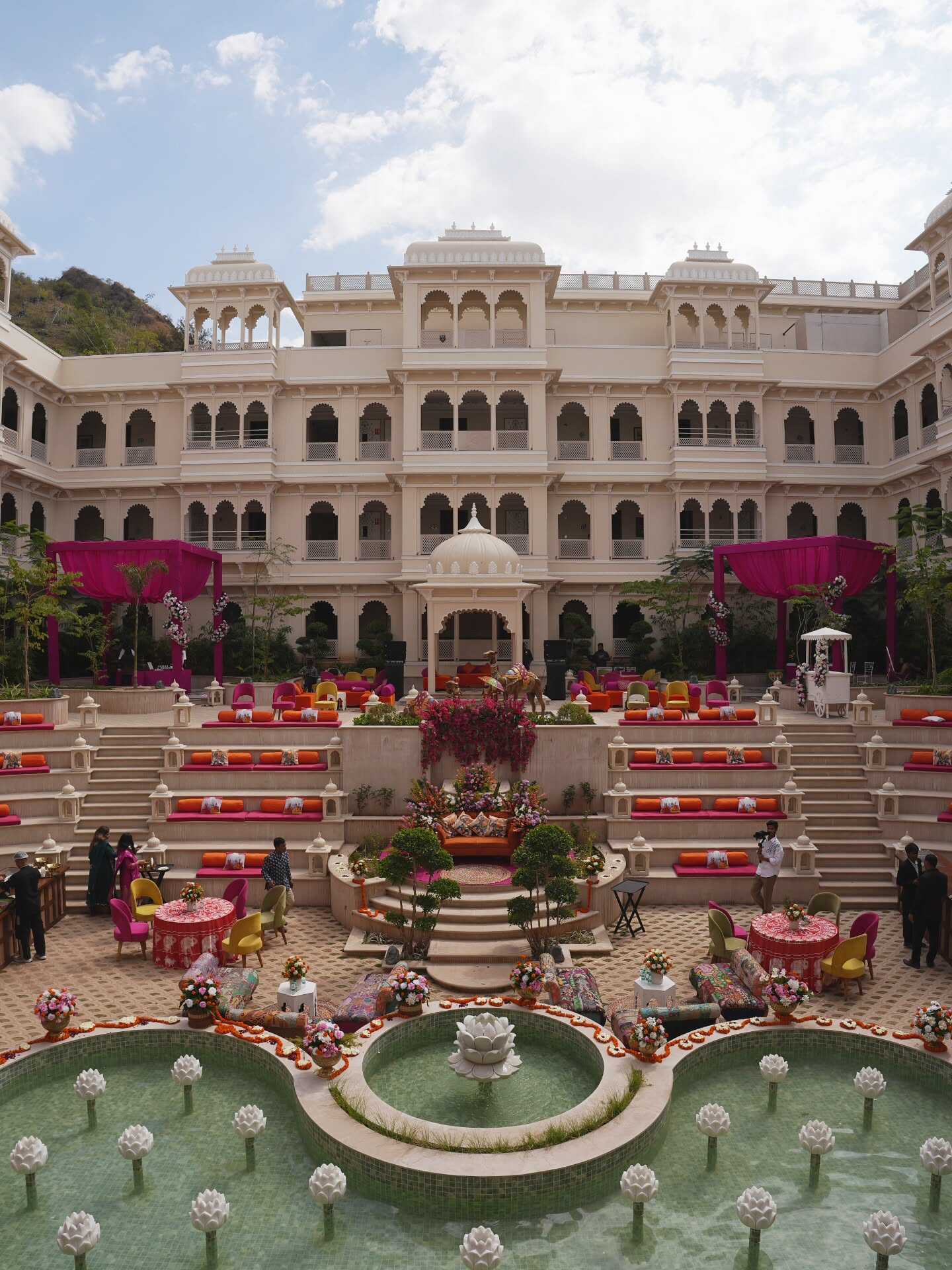
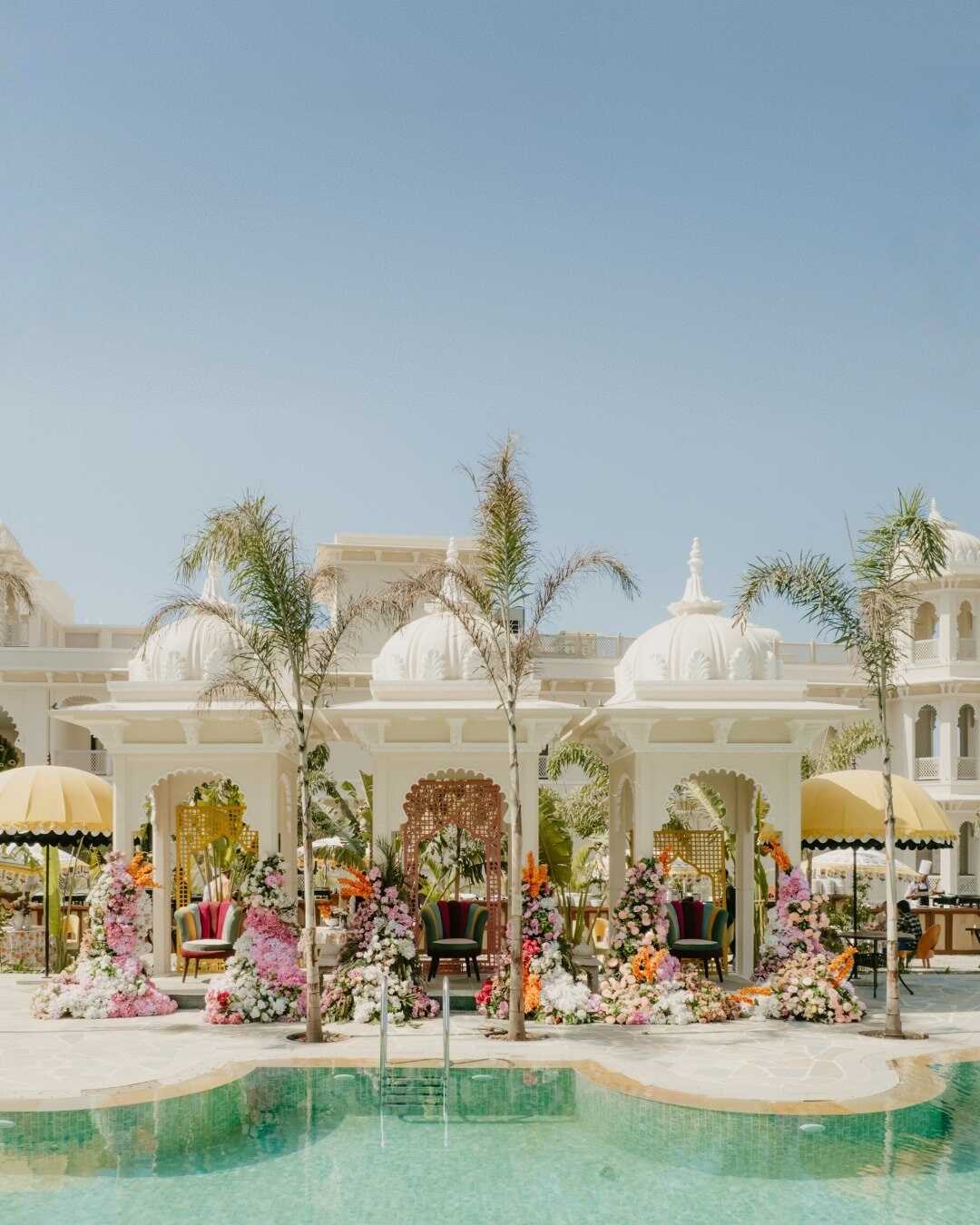
Instead of renovating an old palace or fort, the Wyndham Garden Udaipur was built as a modern resort inspired by palaces, spanning 6 acres in the Aravalli hills, about 25 kilometers from Maharana Pratap Airport. The peacocks still roam the premises, and the sound of birds can be heard on the property just as it would be at any traditional Udaipur estate, but each area there, such as the small Aangan Courtyard and the large Ratnavalli Lawn, was entirely designed with reference to the real requirements of a modern destination wedding.
The resort provides about 1,09,000 square feet of indoor and outdoor event space, along with 72 rooms on site, allowing events to range from small gatherings for 160 guests in the Aangan Courtyard to large celebrations for 2,000 people on its main lawn. For couples seeking Udaipur's atmosphere and level of hospitality without the peculiarities and limitations of a genuinely centuries-old building, the Wyndham Garden Udaipur offers a more modern, purpose-built option.
Suryagarh, Jaisalmer
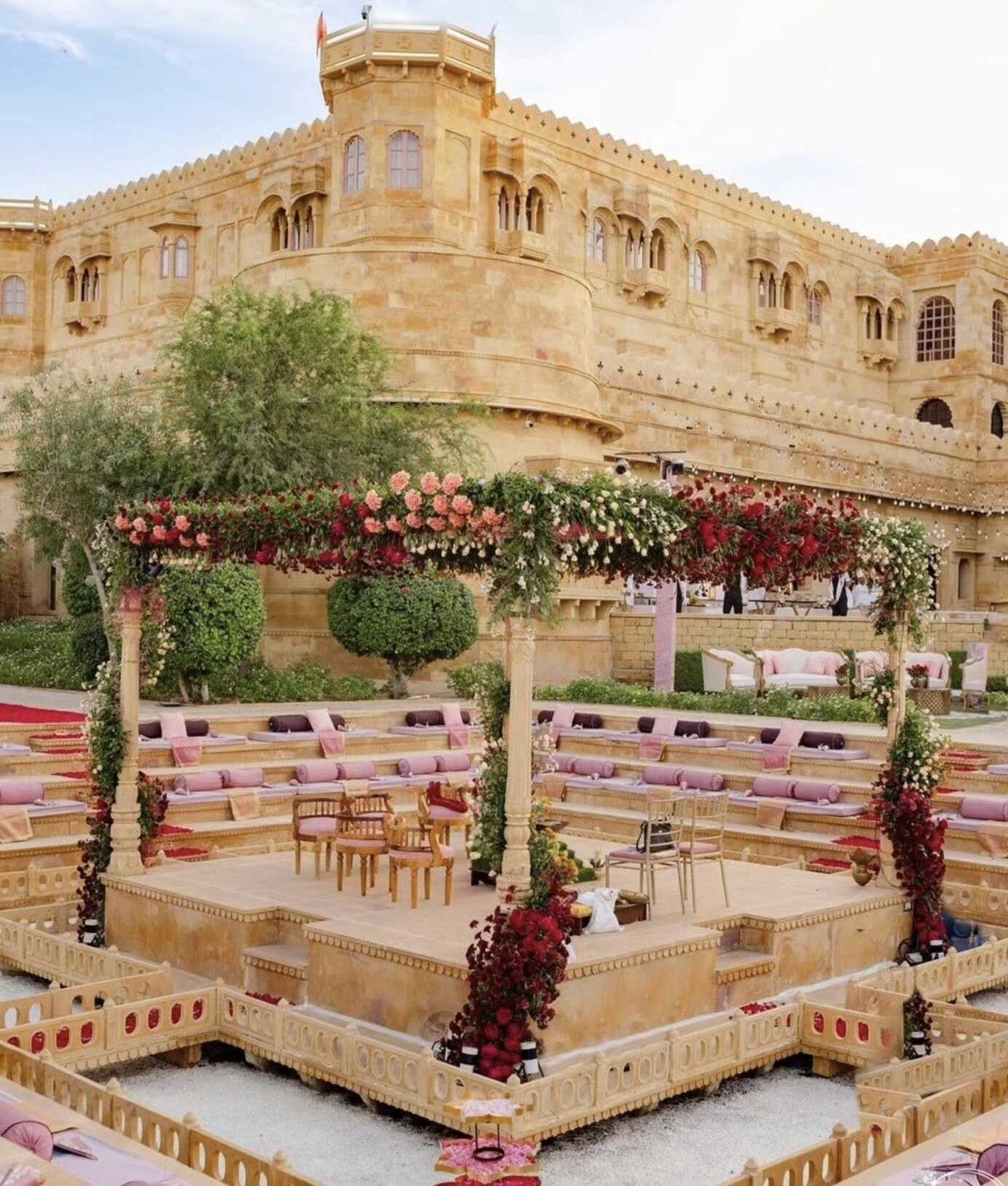
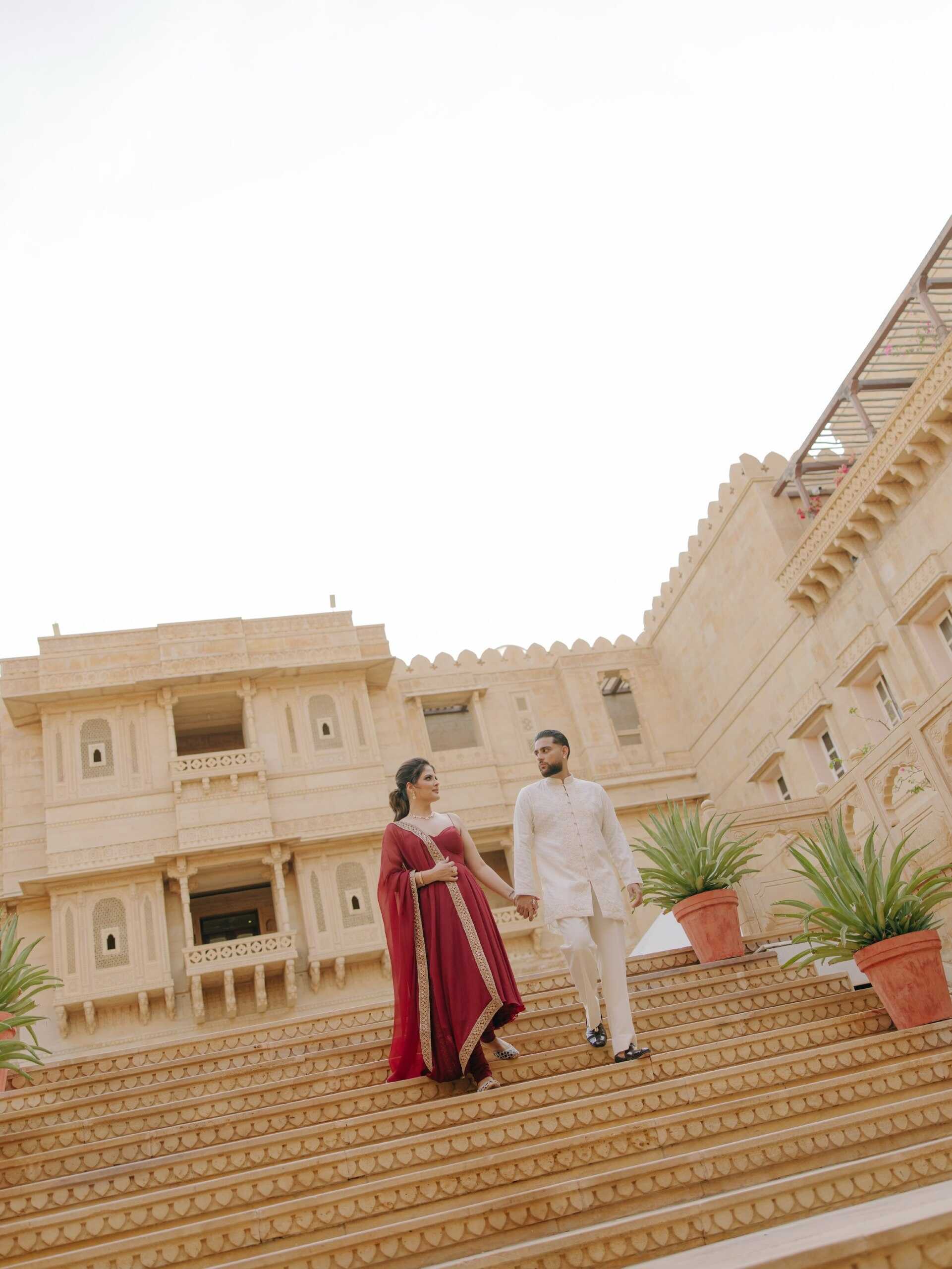
Suryagarh was built new in 2012, designed from the ground up in the architectural tradition of Jaisalmer's sandstone havelis to convey the atmosphere of a real Rajput palace-fort. The effect is so realistic that most first-time visitors assume the property has stood on its hilltop, with the Thar Desert to the west and the old city of Jaisalmer to the east, for centuries rather than just over a decade.
The standout feature of the property, "the Bawdi," is based on traditional stepwell design and provides a truly unique environment for ritual ceremonies, whereas most venues in Rajasthan are unable to reproduce such a setting. Since it has 64 rooms and suites and can accommodate up to 400 guests in the open-air Chowk courtyard, at Rathambhore Hall, and on the Kesariya Terrace, Suryagarh has received recognition from both Condé Nast Traveler India and Travel + Leisure India, awards which are important to couples when deciding between a more modern property and the older palace hotels in Rajasthan.
Fairmont Jaipur
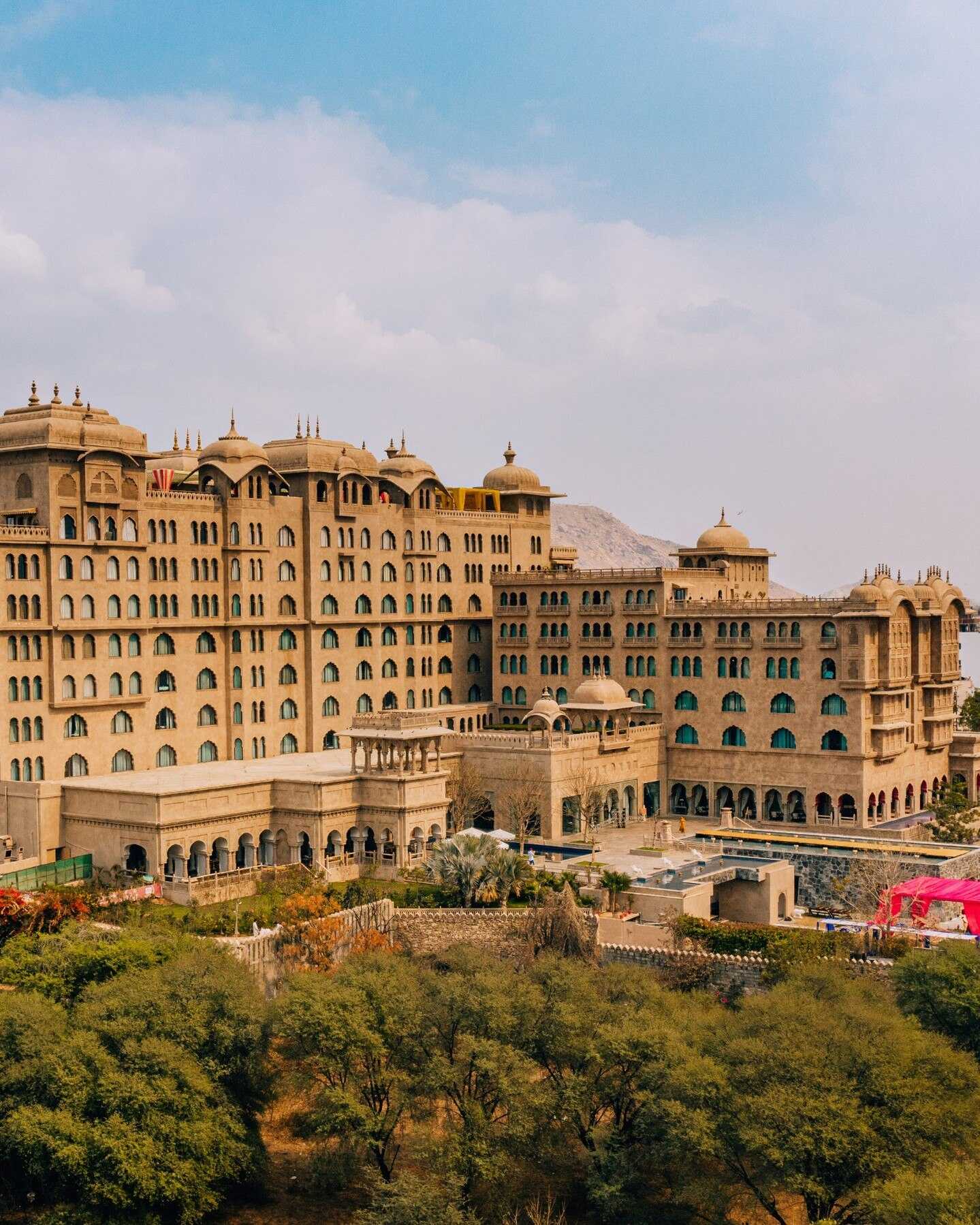
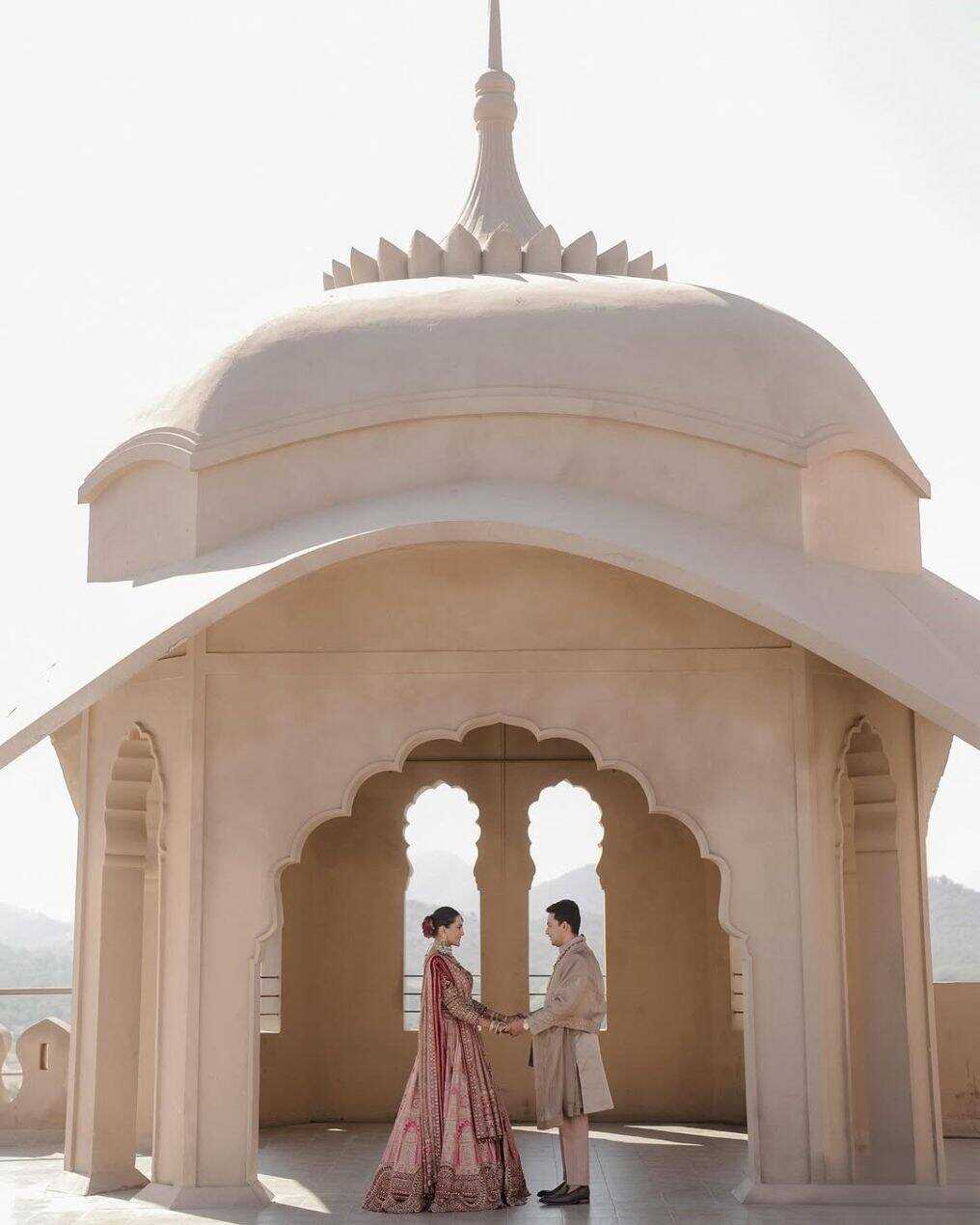
It is the Maharaja Tent that attracts the majority of couples to Fairmont Jaipur, as this permanent Mughal-style structure has been the hotel's most distinctive feature since it opened in 2013, and the high prices charged during the peak wedding season reflect the strong demand for the venue. Situated in Kukas, about 30 minutes' drive from Jaipur airport and only 20 minutes' drive from Amer Fort, the property provides something that few real heritage palaces can offer: 245 rooms, which are enough to accommodate an entire multi-day Indian wedding on one site without the need for any additional accommodation elsewhere in the city.
Capacity scales dramatically depending on which spaces a couple combines:
| Space | Configuration | Capacity |
|---|---|---|
| Rajputana Grand Ballroom | Floating reception | Up to 1,200 |
| Lawn 1 | Sangeet, cocktail evening | Up to 1,000 |
| Lawn 2 | Baraat, large reception | Up to 1,500 |
| All spaces combined | Full-scale celebration | Up to 3,000 |
Grand murals, vintage Shekhawati furniture, and chandeliers evoking Mughal palaces fill the interior, giving Fairmont Jaipur the visual grandeur of a heritage property, despite being purpose-built to the scale modern Indian weddings often require.
Mundota Fort and Palace, Jaipur
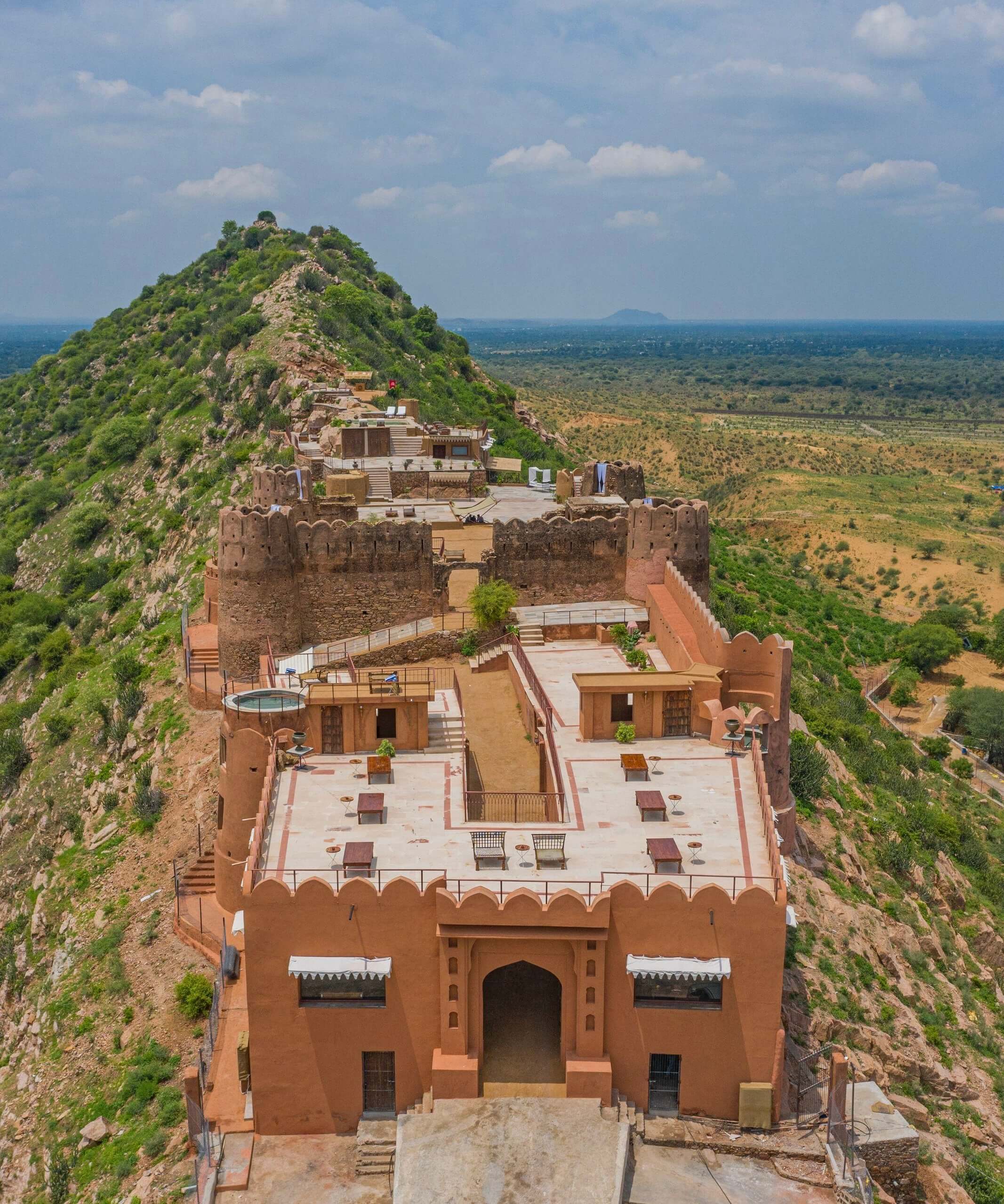
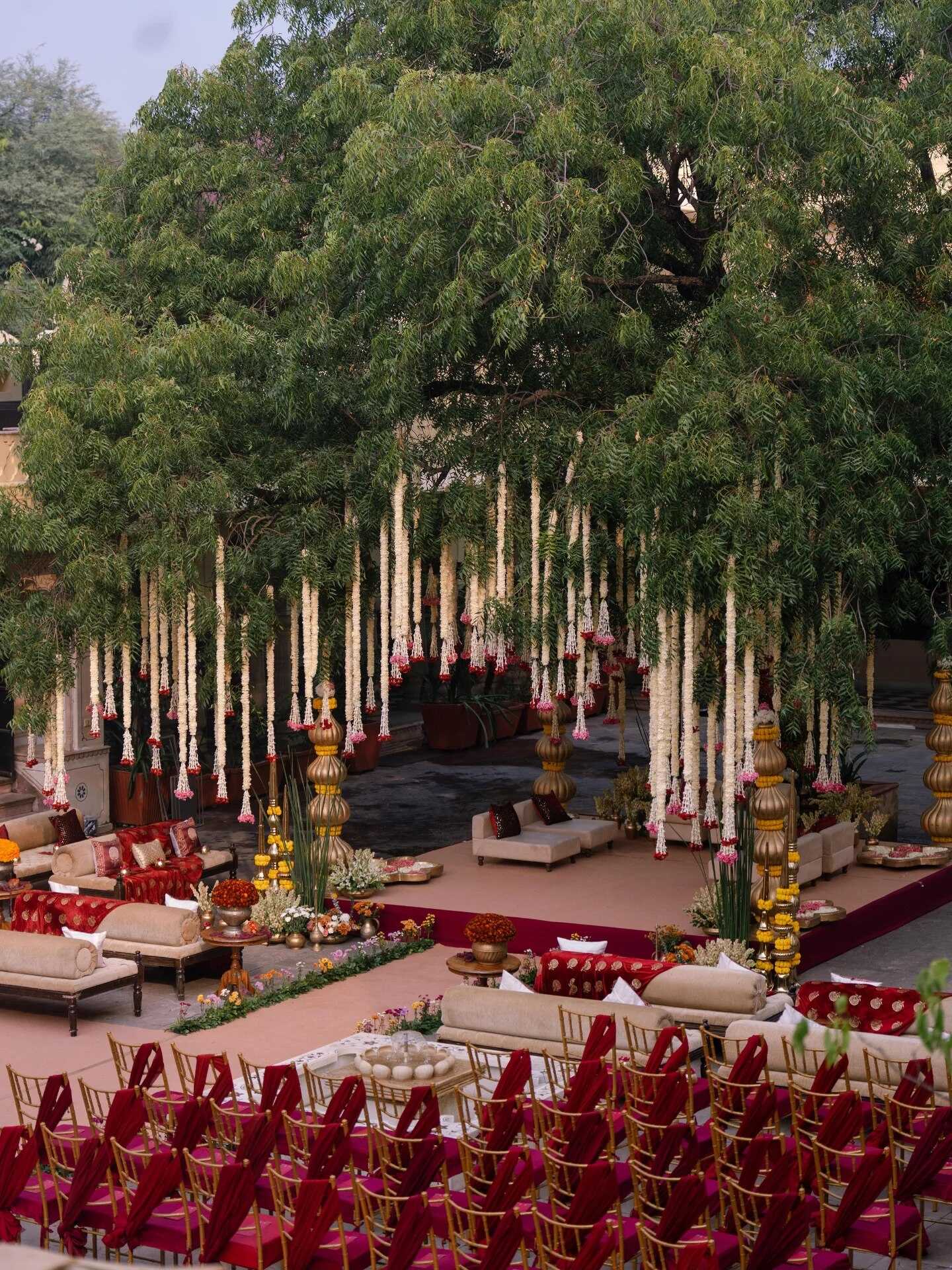
The fort and palace were constructed in the 14th century by the Naruka Rajputs and subsequently captured by the Nathawat Rajputs after a vigorous battle; since then, they have remained in the same family's possession - a continuity that extends over 450 years within the same twenty-acre estate located northwest of Jaipur. The presence of hand-painted frescoes, mirrored antechambers, and courtyards that attract dancing peacocks and flocks of birds gives the property a genuine air of grandeur that cannot be reproduced by more modern buildings.
What sets Mundota apart from other fort hotels in Rajasthan is that it still has its working polo grounds and a sand dune area, both of which are now used for wedding ceremonies, along with some more traditional courtyards and terraces. The property, which has 125 rooms in the palace and fort combined, offers event spaces ranging from the Rangmahal, suitable for 200 guests, to a large lawn of about 2,500 square meters, and as a result, Mundota Fort and Palace regularly hosts weddings of Punjabi, South Indian, and Bengali styles all within the same historic surroundings.
The range of wedding venues in India goes well beyond the 15 mentioned, with havelis in the Shekhawati region, backwater resorts in Kerala, and beachfront properties in Goa, each offering its own particular approach to a destination wedding. You can browse Wezoree's carefully selected collection of wedding venues in India, use filters for region, capacity, and style, and find the venue that precisely matches your plans.

FAQ
What is the best time of year to get married in Rajasthan?
In Rajasthan the peak season for weddings is from October to March, since this period has cooler temperatures and clear skies which are ideal for holding outdoor ceremonies; from April through to September, however, the heat is intense and this makes it genuinely hard to hold outdoor events during the day, although many property owners do provide much lower rates to couples who are willing to plan their weddings around the weather.
How far in advance should we book a palace wedding venue in India?
For the most popular properties, such as Umaid Bhawan Palace, Rambagh Palace, and Taj Lake Palace, it's best to book 12 to 18 months in advance for peak season dates, particularly since they have limited room availability. More modern and larger venues, such as Fairmont Jaipur or Wyndham Garden Udaipur, tend to offer greater flexibility due to their size.
What venues are best suited for very large weddings?
Fairmont Jaipur scales up to 3,000 guests across its combined spaces, and Wyndham Garden Udaipur and Rambagh Palace’s Naksha Lawn both reach 2,000. For couples planning a large traditional Indian wedding with hundreds of guests across multiple functions, these properties offer the infrastructure that smaller heritage hotels simply can’t.
Which venues suit smaller, more intimate destination weddings?
Amanbagh can accommodate full buyouts for 78 to 100 guests, and Taj Lake Palace and Raas Devigarh Palace both work comfortably for celebrations of 80 to 200. Alila Fort Bishangarh and Six Senses Fort Barwara also lean toward intimate, full-property buyouts rather than large-scale receptions.
Do I need a wedding planner for a destination wedding in India?
Given the scale, cultural specificity, and multi-day format of most Indian weddings, an experienced local planner is genuinely valuable - most of these properties work with recommended planners directly, and navigating vendor logistics, permits, and multi-event scheduling is considerably easier with someone who already knows the region.
What is the price range for weddings at these venues?
Costs vary enormously by property and scale. Newer or mid-tier venues like Mundota Fort and Palace, or Alila Fort Bishangarh, can start at $36,000 to $72,000 for a two-day celebration, while palace properties like Umaid Bhawan Palace or Taj Lake Palace often run into several hundred thousand dollars for a multi-day event with a full buyout. Requesting an itemized quote directly from each property is essential, since pricing shifts significantly with season, guest count, and decor scale.