When a Wedding Filmmaker Thinks Like a Musician
AUTHOR: Natali Grace Levine
READING TIME: 6m 21s
PUBLICATION DATE: 10/07/2026
UPDATED: 10/07/2026
AUTHOR: Natali Grace Levine
READING TIME: 6m 21s
PUBLICATION DATE: 10/07/2026
UPDATED: 10/07/2026
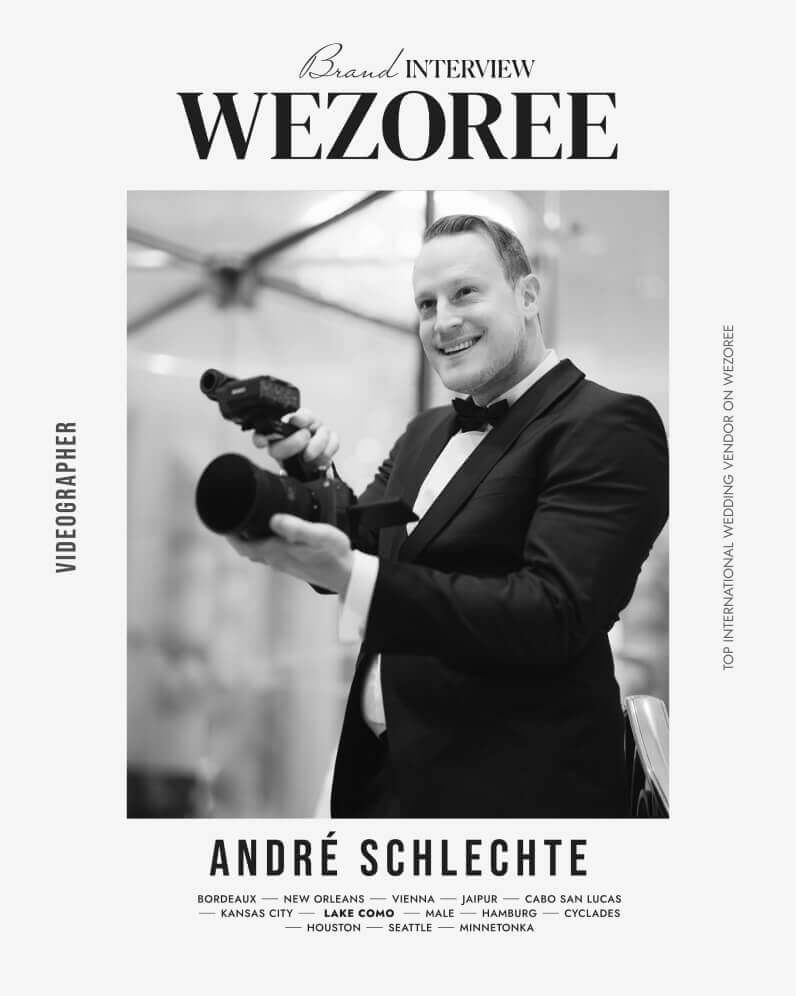
Long before André Schlechte pointed a camera at a wedding, he was chasing a different kind of rhythm—with a guitar, not a lens. He studied sound engineering, wrote his own music, and spent his first years behind a camera on music videos, documentaries, and festival aftermovies before a wedding he wasn’t even hired to film changed the course of his career.
Based in Europe and working out of Italy with clients worldwide, he has spent the past ten years turning that same instinct for rhythm, timing, and restraint into wedding films built to outlast the trends around them.
Filmmaking wasn’t the plan. Music was.
 I started working professionally with video about fifteen years ago, but my path into filmmaking was not completely planned, he says. My first passion was music. I play guitar, I write music, and before I got into video, I studied sound engineering.
But cinema was already part of his life long before it became his profession.
“When I was fourteen, I was already watching films like The Godfather and Once Upon a Time in America. I loved music and cinema, and I kept exploring the history of both, following my own curiosity,” he recalls. “Over time, that gave me a repertoire of influences and a language for storytelling that I still draw on today. Watching movies is still a big part of my inspiration. I pay attention to how a story develops, how music changes what you feel, and how a scene is given time to breathe. I keep learning.”
Those interests came together in his early professional work.
“When I got into video, I worked on music videos, documentary projects, and festival aftermovies for the first five years,” he explains. “Looking back, festival aftermovies were an important bridge into weddings for me. They are also about capturing the atmosphere of a real event, the energy of people coming together, and the emotion of a few unforgettable days.”
André has been filming weddings for ten years, and the one that started it all wasn’t booked—he was simply a guest with a new camera.
“My first wedding happened almost by accident,” André recalls. “A friend invited me to her wedding, and I brought my camera simply because I loved filming and had just got a new camera. I had no real plan to turn it into something. I just captured what I saw and later created a short music-based film from the day.”
What happened next redirected his career.
She had actually booked another videographer, but when she saw my film, she cried and told me it felt so much more emotional and personal to her. That was the first moment I realised that wedding filmmaking could be something meaningful for me.
“Soon after that, I built a website, created a brand, and started taking weddings seriously as a professional path,” he adds.
André keeps his calendar deliberately light.
“For me, the ideal number is around six to ten weddings per year. That allows me to stay creatively invested in every project and give each film the depth it deserves,” he explains. “A wedding film is not just the wedding day itself. The post-production alone can take weeks of focused work, especially when you want the film to feel personal rather than formulaic.”
The scale of that work becomes clearer when he describes what comes home with him after a wedding.
“I might have six to ten hours of footage, and I go through every second of it. Between the speeches and the ceremony, there can be around three hours of potential storytelling material alone. Then you have to shape all of that into a seven- to ten-minute film,” he says. “You have to decide what belongs, what to leave out, and when each moment should appear. That is the craft of storytelling.”
Finding his own way of doing that took time.
It took me years to really find my style. I can question a decision endlessly because I always want to make the best film I can. But I’ve learned to trust my intuition—to recognise when something feels right and know when to let it stand.
What draws André back to this work, year after year, extends beyond the editing room.
“There are many parts of the process I love. I love the anticipation before a wedding, the atmosphere of welcome events, the emotional intensity of the wedding day, and the feeling of shaping all of that into a film afterwards.”
Trust from his clients is central to that process.
“I also love the creative freedom. My clients trust my perspective, and that allows me to work very intuitively,” he says. “I’m a very empathetic person. I think I’m good at sensing how people feel and who they are, and that helps me make a film that feels like them. It guides the music, the pacing, and the structure. I put my ego aside and direct those choices toward the couple.”
That freedom comes paired with responsibility.
“What makes wedding filmmaking special is that it combines art with responsibility,” he reflects. “I get to express myself creatively, but the work is never just about me. It is about preserving something deeply personal for the couple and their families.”
There is a personal reward, too.
I love that this work takes me to beautiful places and allows me to meet people I would never otherwise meet. It is a demanding job behind the scenes, but the emotional reward is very real.
Asked to name a wedding that has stayed with him, André describes a private estate wedding built on quiet, unrepeatable details.
“One wedding that has stayed with me was a private estate wedding with an incredible emotional atmosphere,” he begins. “The couple married on a beautiful family property, with stunning floral design by Tulipina. Being on the family’s own property made the day feel especially personal.”
One moment in particular has stayed with him.
“One of the most moving moments was the bride’s entrance,” he recalls. “She began walking with her father, and halfway through, her grandfather joined them. She was very close to him, and the image of three generations walking together was incredibly powerful.”
He describes the day as a whole in similar terms.
“The whole wedding had so much warmth. The couple, the family, the setting, the emotions—everything felt deeply genuine. I also had the honor of working alongside photographer Jose Villa, which made the experience even more meaningful for me.”
Looking back, he sees that day as a turning point in how he understands his own work.
“That wedding helped me understand even more clearly why this work matters,” he says. “We are not just filming a beautiful event. We are preserving family history.”
For André, understanding a filmmaker’s work takes more than watching a few short clips.
When you’re choosing a photographer, you can look through a collection of images and begin to get a feel for their eye and their style. With film, you also need to experience how a story unfolds over time,
he explains. “A sixty-second teaser can look beautiful, but it can only tell you so much about the full film.”
He sees those short pieces as useful, while recognising the different purpose they serve.
“Planners, photographers, and filmmakers all use Instagram for marketing. Teasers are part of that, and they have a place. But imagine going to the cinema and leaving halfway through the film. You would have an impression, but you wouldn’t know where the story was leading or how everything would come together,” he says. “The pacing, the relationships between moments, the emotional build—all of that needs time.”
His priority is the film that remains with the couple.
“For me, the main work is the seven- to ten-minute wedding film. That is the film the couple will return to in ten, twenty, or thirty years. I want it to hold their attention and bring them back to how it felt to be there.”
That emphasis on the complete story also shapes what André chooses to capture.
“One trend I see right now is a very stylized, staged, Wes Anderson-inspired approach. I understand the appeal, and some of it can be visually fun. But my own philosophy is different. I’m most drawn to the moments that happen naturally. Rather than creating scenes for the camera, I want to notice what is unfolding around me and capture how it feels,” he says.
“For me, the real story of a wedding is already there. It is in the speeches, the vows, the glances, the reactions, and the atmosphere between people. I do not feel the need to invent a new story by staging moments that mainly exist to look good on Instagram.”
His musical background surfaces again here, this time as a working philosophy.
As a musician, I often compare it to playing in a band. A great drummer does not constantly play solos to prove how good they are. They support the song. That is how I see wedding filmmaking. My job is not to put my ego in front of the event. My job is to support the emotional truth of the day.
He wants his films to remain meaningful to the families who will return to them over the years.
“Trends can be exciting, but, in my opinion, wedding films should outlast trends,” he adds. “What feels cool on Instagram today may feel dated in a few years. A wedding film should still feel honest and meaningful twenty years later.”
André’s advice to couples starts with a simple sequence.
My biggest advice is: plan carefully, choose the right people, and then let go,
he says.
He’s candid about why the third part matters as much as the first two.
“A wedding comes with so much pressure, especially when it is a major investment and something you may have imagined for years. But if you try to control every detail on the actual day, it can become a recipe for disappointment.”
Choosing people whose work and judgement you trust is part of that preparation.
“Choose a planner who truly understands you. Choose a photographer and filmmaker whose work you connect with on a deeper level. And especially with video, watch at least one full film of the filmmakers you are interested in,” he says. “Can they hold your attention? Can they tell a story? Can they make you feel something beyond pretty images?”
On the day itself, his advice simplifies down to being present.
Things may go wrong. That is normal. But if you are surrounded by the right team, you can trust them to handle the details while you enjoy the people you love.
Fifteen years into a video career and ten years into weddings, André still finds motivation in the many disciplines the work brings together.
“Filmmaking brings together observation, timing, sound, music, editing, color, pacing, storytelling, and emotional sensitivity,” he reflects. “You have to capture the day while it is happening, but you also have to understand later how all those pieces belong together.”
For André, that is where the value lies.
“Wedding filmmaking is a luxury not because it is flashy, but because of the care, experience, and time required to do it well,” he says. “A wedding only happens once. You do not get another chance to choose the right person to preserve it.”