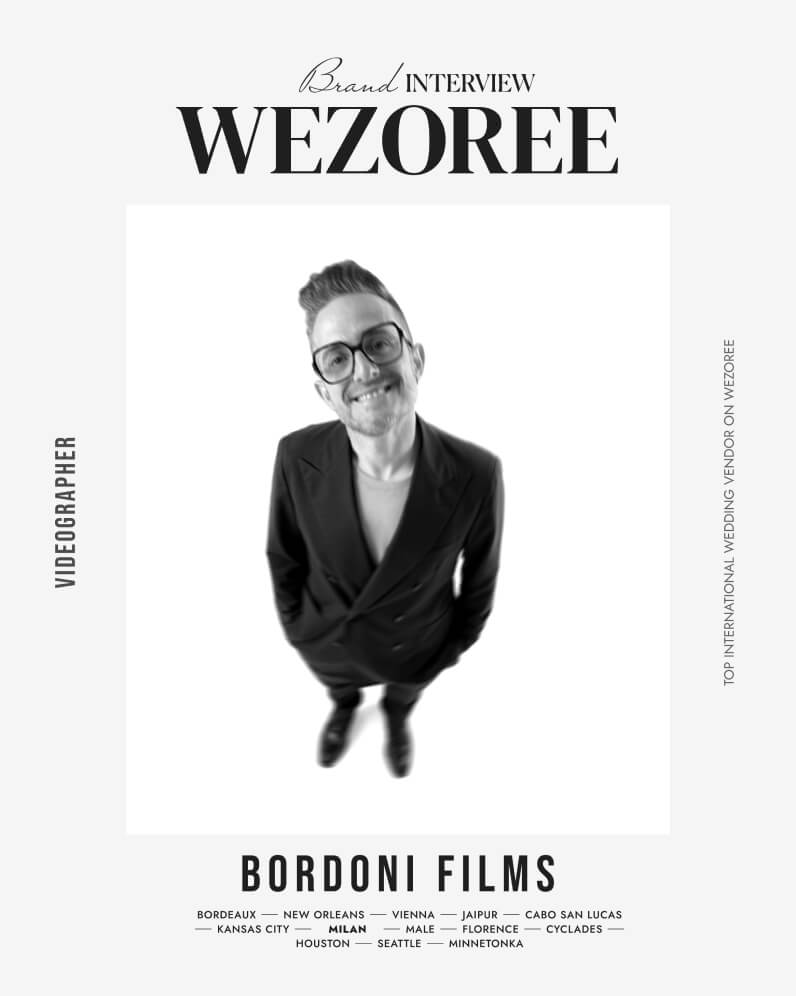
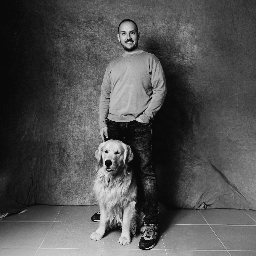
Some wedding films are built around spectacle. Others stay with you because they preserve something far more elusive — atmosphere, rhythm, and the emotional truth of a gathering. That balance defines the work of Alessandro Bordoni, founder of BORDONI Films.
Founded in Milan and now operating between Europe and the United States, BORDONI Films approaches weddings with the language of cinema and the instincts of documentary filmmaking. Alessandro’s work does not rely on formulas or repeated structures. Instead, each film responds to the place, the people, and the energy that unfolds naturally over the course of a celebration.
With more than a decade of experience documenting multi-day weddings in places like Lake Como, Tuscany, the French Riviera, Napa Valley, Aspen, and Charleston, Alessandro has developed a style that feels immersive, elegant, and deeply attuned to human connection.
We spoke with him about his creative background, his philosophy, and the quiet moments that often become the emotional center of a film.
A Filmmaking Language Shaped by Place and Observation
BORDONI Films began in Milan, but its visual language was never limited to one geography.
“Bordoni Films was founded in Milan and today operates between Europe and the United States. The studio is shaped by an Italian sensibility for place and restraint, combined with a contemporary international production language.”
Before wedding filmmaking became the core of his work, Alessandro was already building a strong cinematic foundation.
“I come from a background in documentary work, music films, and international campaigns, and that experience naturally shaped how I approach wedding filmmaking.”
That background continues to inform the way he sees celebrations — not as isolated moments to capture, but as living environments unfolding over time.
 Rather than treating celebrations as isolated events, I look at them as environments that unfold over time. Light changes, energy builds, and intimacy reveals itself gradually.
His role within that environment is intentionally restrained.
“My role is simply to observe that rhythm and translate it into film without interrupting it.”
More Than a Decade of Wedding Filmmaking
Alessandro began filming weddings over ten years ago, long before destination celebrations became such a prominent part of the industry.
“I began filming weddings more than ten years ago. What started as occasional commissions gradually evolved into a dedicated studio as the demand for this type of storytelling grew.”
As the work expanded, so did the geography of the studio.
“Over time the work naturally expanded beyond Italy, and today the studio operates between Europe and the United States, focusing primarily on multi-day celebrations and destination gatherings.”
That international experience has shaped not just the logistics of the work, but the way Alessandro reads different environments and family dynamics.
Where Documentary Observation Meets Cinematic Storytelling
Ask Alessandro to describe the style of BORDONI Films, and the answer sits in a beautiful in-between space.
“Our style sits somewhere between documentary observation and cinematic storytelling.”
Rather than directing a wedding into a sequence of perfect visuals, he remains attentive to what is already happening.
“We don’t approach a wedding as a sequence of staged moments. Instead, we stay attentive to what naturally unfolds throughout the celebration. Small interactions, shifts in atmosphere, the way people move through a place.”
That commitment to authenticity is one reason the films never feel repetitive.
“One thing people often notice is that our films rarely resemble one another. That is very intentional. Each production responds to the character of the couple, the environment, and the creative direction of the celebration.”
He is also highly aware of the larger visual world surrounding the film.
“We also pay close attention to the visual language created by the planning and design teams, as well as the photographer we are collaborating with.”
When those creative forces align, something stronger emerges.
“When those elements move in the same direction, the film becomes part of a larger aesthetic vision rather than an isolated layer of coverage.”
Cinema-Level Tools with a Discreet Presence
In wedding filmmaking, gear matters — but for Alessandro, what matters more is how it behaves within a real environment.
“We work within the Sony Cinema ecosystem, primarily using the FX3 and FX6 cameras.”
Still, his approach is never gear-driven.
“What matters most to us, however, is not the equipment itself but how it allows us to work within the environment.”
Because many of the celebrations he documents are multi-day events with many moving parts, discretion is essential.
“Our productions are designed to remain visually discreet and unobtrusive, so the tools we choose are intentionally compact while still delivering cinema-level image quality.”
Preparation is what allows that discretion to function at a high level.
“Because much of our work happens during multi-day celebrations with many moving parts, we spend significant time in pre-production understanding the rhythm of the event.”
The objective never changes.
“The goal is always the same: preserve the guest experience while capturing the celebration with the highest level of clarity and intention.”
The Meaning of Filming People Together
For Alessandro, one of the most compelling parts of wedding filmmaking is not just the couple, but the collective presence around them.
“What I enjoy most is observing how people experience a moment together.”
Weddings create a unique social environment — one that cannot be manufactured.
“Weddings create a rare environment where different generations, friendships, and cultures gather in one place.”
Within that environment, certain images stay with him.
“A couple seeing the reception space for the first time, a quiet conversation between old friends, or a pause on a terrace while taking in the landscape.”
These are not always the loudest moments, but often the ones that hold the deepest feeling.
“Being able to quietly observe those moments and preserve that atmosphere in film is what continues to make the work meaningful.”
Building the Film Around What Matters Most
Every celebration begins with listening.
“Every celebration begins with understanding what matters most to the couple.”
Before cameras, before timelines, before edits, Alessandro wants to understand how the couple sees their own gathering.
“Before the event we usually spend time in conversation, often over a call, simply listening. Each couple experiences their celebration in a different way, and understanding those priorities helps guide how the film will be approached.”
At the same time, wedding filmmaking is never created in isolation.
“Our work sits within a larger creative collaboration. We work closely with planners, designers, photographers, and the wider team so that the film reflects the overall vision that has been created for the celebration.”
The process is one of careful balance.
“Much of the process is about balance. Listening carefully, understanding the atmosphere being designed around the couple, and translating those elements into a film that feels personal and natural to them.”
Advice for Couples: Create a Celebration That Feels Like You
Alessandro’s advice to engaged couples is less about trends and more about emotional truth.
“Focus on creating an experience that feels natural to you rather than trying to reproduce something you’ve seen elsewhere.”
The celebrations people remember most deeply are rarely the ones trying hardest to impress.
“The celebrations that stay with people the longest are usually the ones where couples remain present and allow the atmosphere to unfold around them.”
And trust matters — not only in one vendor, but in the entire creative team.
“Choosing collaborators you trust also makes a significant difference. When the creative teams move in the same direction, the entire celebration feels more effortless for everyone involved.”
Destination Weddings Across Continents
Most of the weddings Alessandro documents are destination gatherings.
“Yes, most of the celebrations we document are destination gatherings. Our work moves naturally between Europe and the United States, following our clients wherever their celebrations take place.”
If asked to choose one destination closest to his heart, the answer is clear.
“If I had to choose a favorite, Italy remains very special to me.”
But his appreciation goes beyond sentiment.
“Beyond being where I’m from, there is a particular atmosphere there. The landscape, architecture, food, and pace of life create a natural setting for celebrations that is difficult to replicate elsewhere.”
Still, what fascinates him most is how distinct each place feels.
“A weekend on Lake Como feels very different from the French Riviera, Napa Valley, or the mountains of Aspen.”
The Weddings That Stay With You
Not every memorable wedding is defined by scale or design. For Alessandro, the most unforgettable ones are often about connection.
“The ones that stay with me the most are usually the celebrations where a real connection forms with the couple and their families.”
Sometimes a wedding leaves behind the feeling that you would happily relive the whole weekend.
“When the atmosphere feels genuine, when the energy between people is natural, and when you feel welcomed into that environment rather than simply documenting it.”
Those are the experiences that linger well beyond delivery day.
“When that happens, the film becomes more than a project. It becomes a shared memory.”
The Power of Unexpected Moments
In Alessandro’s work, the most emotional moments are often not the ones anyone planned.
“The most unexpected moments are often the simplest ones.”
A glance, a speech, an arrival no one saw coming — those small shifts can transform the emotional tone of a film.
“Sometimes it’s a quiet interaction that wasn’t planned at all. A parent seeing their child in a wedding setting for the first time, an old friend appearing unexpectedly, or a spontaneous speech that changes the atmosphere of the evening.”
These moments matter because they reveal something unfiltered.
“They often become the emotional center of the film because they reveal something genuine about the people involved.”
And being able to recognize them in real time is part of the craft.
As filmmakers, learning to recognize those moments as they happen is one of the most important parts of the work.
A Shot That Still Brings a Smile
Among the many sequences Alessandro has filmed, one still stands out with particular clarity.
“One shot that always makes me smile was an early FPV racing drone sequence we filmed inside a glasshouse reception at Cliveden House during a celebration in the English countryside.”
The setting itself was extraordinary.
“The space was entirely transparent, surrounded by landscape and dressed with an extraordinary floral and candle design.”
The intention behind the shot was architectural as much as cinematic.
“The idea was to move through the room in one continuous motion before guests arrived, revealing the atmosphere and scale of the setting exactly as it had been designed.”
Executing that shot required both precision and trust.
“Flying a racing drone in that kind of environment required careful preparation and a great deal of trust in the team.”
When it worked, it opened something creatively new.
“Moments like that are a reminder of how thoughtful collaboration and experimentation can open new creative possibilities.”
The Emotional Weight of Family Speeches
There are certain moments in weddings that consistently move Alessandro, and many of them come through words rather than visuals.
“A moment that often carries emotional weight is when a parent speaks about their child during the celebration.”
Having grown up in Italy, he is particularly sensitive to the openness with which some families express those emotions publicly.
“Hearing a parent revisit a lifetime of memories in front of everyone can be very powerful.”
Another meaningful moment arrives much later — often before the film itself has even been seen.
“At the end of the celebration, couples come to us with genuine excitement and gratitude, often before they have seen a single frame of the film.”
That reaction says something important about the experience itself.
“Those moments are a quiet reminder that the atmosphere created around a gathering can be just as meaningful as the film that follows.”
Preserving What Time Usually Erases
Looking back on years of wedding filmmaking, Alessandro has come to see celebrations in a particular way.
“Over time, I’ve come to see weddings less as events and more as gatherings that hold a particular moment in people’s lives.”
Because while specific details may fade, something more essential remains.
“Years later the details may fade, but the atmosphere of that time, the people who were present, and the way it all felt together tends to remain.”
And that, ultimately, is the work.
“If a film can preserve even a small part of that, then it has done its job.”
For BORDONI Films, wedding filmmaking is not about forcing emotion or manufacturing beauty. It is about paying close attention — to place, to people, to rhythm, to silence — and shaping all of it into something lasting.
Something honest. Something cinematic. Something that still feels alive years later.